Trailer stabilisers are a valuable towing aid, especially for caravans, horse trailers and other high-sided trailers. However, they are not a cure-all. A stabiliser will not compensate for poor loading, incorrect nose weight or bad driving habits.
Used correctly, stabilisers help improve towing stability and reduce the risk of trailer sway - often referred to as snaking. Used incorrectly, they can give a false sense of security.
This guide explains what stabilisers do, how snaking happens, how to react safely, and how to inspect and service stabilisers properly.
What Is a Trailer Stabiliser?
The main purpose of a stabiliser is to reduce lateral movement between the towing vehicle and trailer. When a trailer starts to sway from side to side, the stabiliser applies resistance, helping bring the trailer back into line before instability escalates.
Stabilisers come in several designs, but the most common types are:
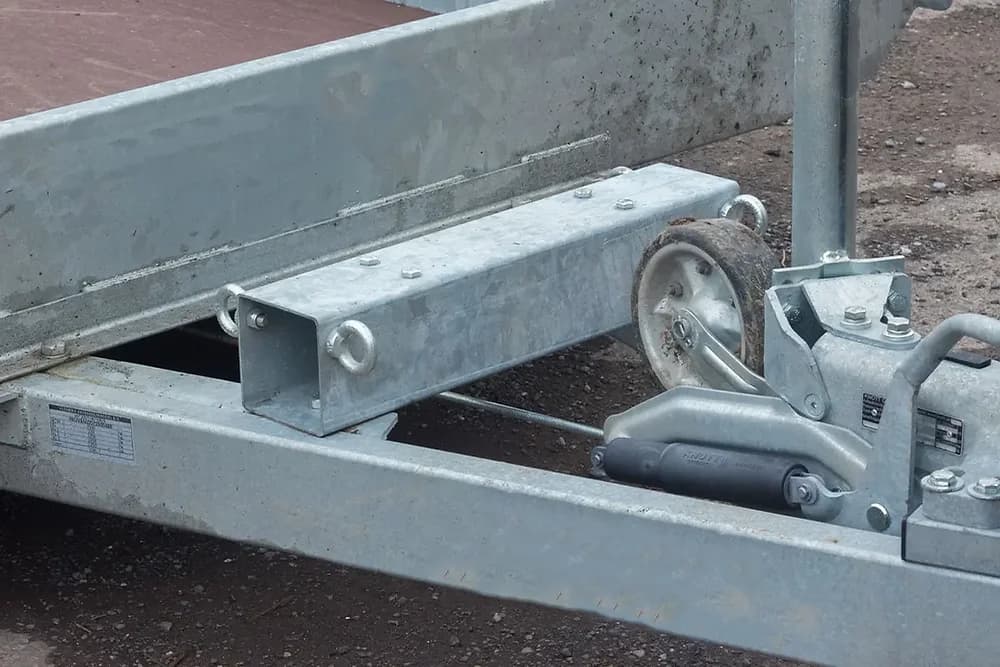
Trailing arm / leaf spring stabilisers
Coupling head stabilisers (often integrated into caravan hitches)
They are particularly effective on:
Caravans
Horse trailers
Box trailers
Other high-sided trailers
Stabilisers Are Not a Substitute for Correct Towing
Before relying on a stabiliser, the fundamentals of towing must be correct.
The Golden Rules of Towing
The trailer must sit level when coupled to the towing vehicle
Nose weight should be between 50-100kg (unless the trailer is very light)
Tyre pressures on both vehicle and trailer must be correct
Loads must be evenly distributed and secured
It’s also worth remembering:
You must not use the right-hand lane of a motorway with three lanes or more when towing a trailer
A stabiliser can assist stability - it cannot fix incorrect setup.
What Is “Snaking” and Why Does It Happen?
Snaking occurs when the trailer axles move out of line with the towing vehicle. As the trailer tries to correct itself, it overcompensates, creating an oscillating side-to-side motion.
If left unchecked, snaking will:
Increase rapidly
Reduce driver control
Potentially lead to jack-knifing or rollover
Common Causes of Trailer Snaking
Snaking can be triggered by one or more of the following:
Incorrect load placement (too much weight behind the axle)
Very light or negative nose weight
Strong side winds
Turbulence from large vehicles overtaking
Special-purpose trailers with awkward or uneven internal layouts
Even a well-maintained stabiliser cannot fully counteract these issues if the trailer is badly loaded.
What To Do If Snaking Starts
If trailer snaking begins, driver reaction is critical.
Correct Actions
Keep the steering straight
Change down a gear
Take both feet off the pedals
If descending downhill, gently apply the brakes while remaining in a lower gear
What NOT To Do
❌ Do not accelerate - this can rapidly worsen the situation
❌ Do not brake hard - this risks jack-knifing
❌ Do not try to steer out of the sway - this often increases instability
The goal is to reduce speed smoothly and allow the stabiliser to work.
Stabiliser Checks (Before Every Journey)
Each stabiliser manufacturer provides specific inspection guidance, but the following checks should be carried out before every trip:
Ensure friction is present (where applicable)
Check the stabiliser is correctly seated in its locating position
Confirm there is no excessive movement or visible damage
A stabiliser that isn’t properly engaged offers little benefit.
Stabiliser Servicing Requirements
Stabilisers should be fully overhauled at least once a year or after 20,000 miles of towing, whichever comes first.
Servicing should include:
Complete dismantling
Inspection of friction pads or disks
Checking for cracking, glazing or excessive wear
⚠️ Important safety note:Some older stabilisers may contain asbestos-based friction material. These components must be handled and disposed of carefully in accordance with regulations.
Common Stabiliser Problems & Remedies
Problem | Likely Cause | Remedy |
Groaning noise when manoeuvring slowly | Friction material transferred to metal parts | Dismantle and clean metal components |
Leaf spring jumps out of chassis shoe | Excessive tension on friction disks | Check and reduce operating tension |
Leaf catching A-frame | Incorrect chassis shoe position | Check articulation and reposition shoe |
Addressing these issues early prevents further damage and restores stabiliser effectiveness.
Brent’s Bottom Line
A stabiliser is a valuable safety aid, not a safety net. When combined with correct loading, sensible speeds and good driving technique, it can significantly reduce the risk of trailer instability.
If you’re relying on a stabiliser to fix poor setup, you’re asking too much of it.
Set the trailer up properly first - then let the stabiliser do the job it was designed for.
-Brent