
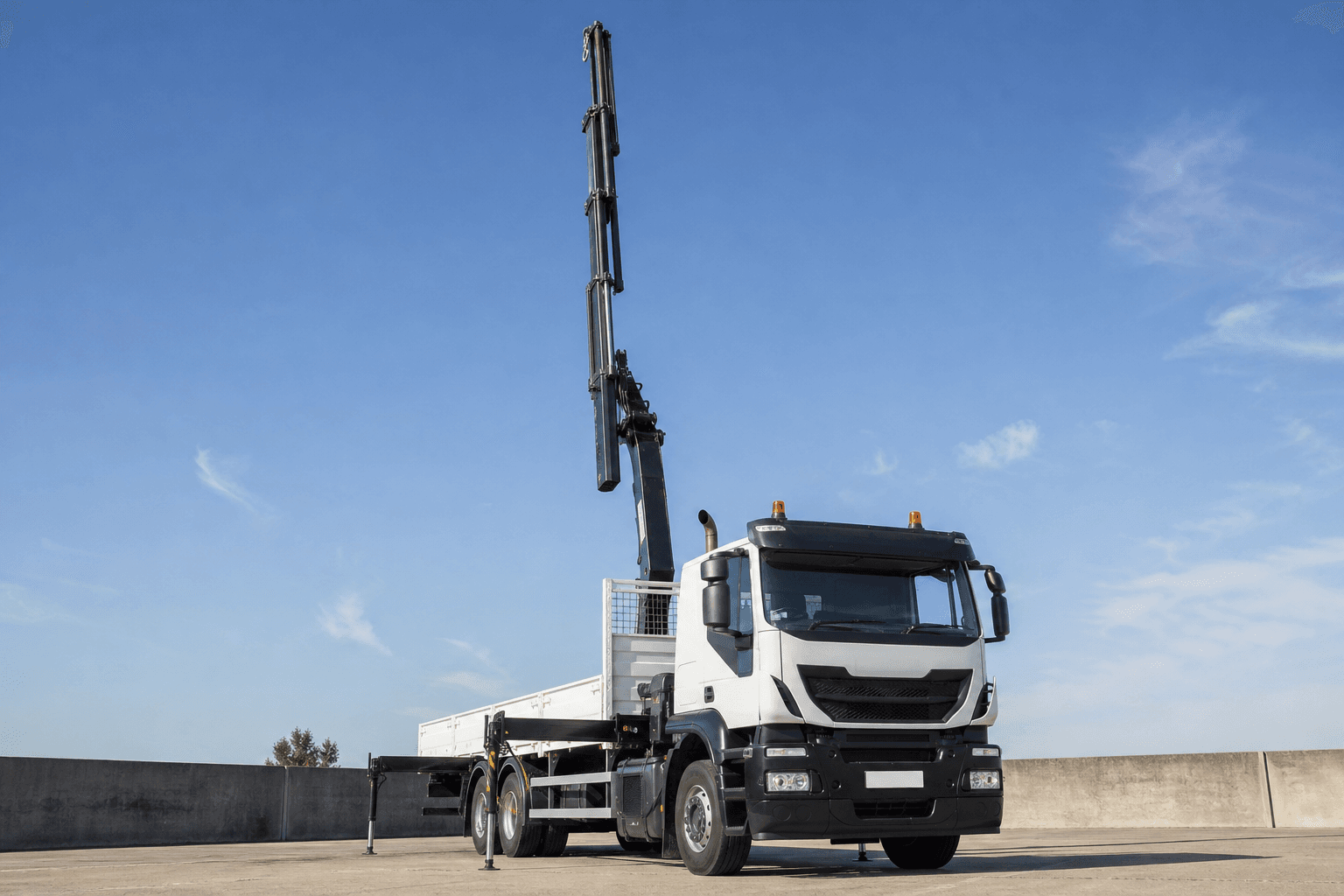
A HIAB lift involves more preparation than simply booking a lorry and waiting at the kerb. Get the groundwork wrong and the vehicle may arrive to a site it cannot legally or safely use, turning a straightforward delivery or placement job into a costly delay. This guide sets out the key requirements - covering highway permissions, health and safety law, operator qualifications, and site readiness - so that everything is in order before the lorry arrives.
What a HIAB Actually Is
A HIAB truck is a lorry fitted with a hydraulic articulated crane mounted directly behind the cab. HIAB is in fact a brand name, derived from the Swedish words Hydrauliska Industri AB. The company produced the first commercial truck-mounted hydraulic loader crane in 1947, and the name became so widely adopted that "HIAB" is now used generically across the UK to describe any lorry-mounted crane, regardless of manufacturer.
A standard lorry requires a forklift, crane or telehandler at the delivery point to offload goods. A HIAB truck carries its own crane, eliminating the need for any ground-based lifting equipment. This saves time and means deliveries can be made to sites with no lifting facilities - including residential addresses, roadside locations and greenfield sites.
For most straightforward lifting jobs, a HIAB is appropriate. If the load exceeds what a lorry-mounted crane can handle, or the lift height is significant, a different type of crane may be needed - in which case the operator will advise. For help finding the right vehicle, browse specialist vehicle hire options across the UK.
Highway Authority Licences and Permissions
Section 169 of the Highways Act 1980 regulates scaffolding and other structures, including cranes, erected on or over the highway in connection with building or demolition work or the alteration, repair, maintenance or cleaning of any building. It is an offence to place any such equipment before applying for a licence.
The licence is issued by the local highway authority - typically the county or unitary council for most roads, or Transport for London on its network. The term highway includes footpaths, cycleways, verges, and roads. This means a HIAB parked on a pavement apron, with its jib swinging over a public footpath, is caught by these rules even if the lorry never moves from private land.
Some authorities require longer notice periods, so confirm timescales with the relevant council well in advance. The hire company or contractor will often manage the application on the client's behalf, but the responsibility for ensuring the licence is in place before the crane operates sits with the licence holder.
The licensee must undertake a comprehensive risk assessment to address every aspect of the building, operation, maintenance and dismantling and removal of the crane, and the effect of and on all types of traffic that will pass under or nearby the crane.
If pedestrian diversion is needed, Traffic management must comply with the requirements set by the highway authority. Confirm all these conditions with the issuing council before planning the lift.
Health and Safety Law: LOLER and the Lift Plan
The Lifting Operations and Lifting Equipment Regulations 1998 (LOLER) place duties on people and companies who own, operate or have control over lifting equipment. This includes all businesses and organisations whose employees use lifting equipment, whether owned by them or not.
All lifting operations involving lifting equipment must be properly planned by a competent person, appropriately supervised and carried out in a safe manner. LOLER also requires that all equipment used for lifting is fit for purpose, appropriate for the task, suitably marked and, in many cases, subject to statutory periodic thorough examination.
The Health and Safety Executive enforces LOLER across Great Britain. LOLER requires that all equipment used for lifting is fit for purpose, appropriate for the task, suitably marked and, in many cases, subject to statutory periodic thorough examination.
The person carrying out a thorough examination must have appropriate practical and theoretical knowledge and experience of the particular lifting equipment. This knowledge and experience will enable them to detect defects or weaknesses and to assess their importance in relation to the safety and continued use of the equipment.
As the person commissioning a lift, you are entitled to ask the hire company for evidence that the equipment has been thoroughly examined within the required period. A reputable operator will supply this without hesitation.
Operator Qualifications
When booking a HIAB, confirm that the operator holds recognised certification.
The DVSA has noted an increased number of HIAB-fitted HGVs on UK roads and has been involved in prosecutions where vehicles were found to be non-compliant with length and weight rules. This is the operator's responsibility, but it is worth understanding when specifying the job.
Site Preparation Checklist
The operator will carry out their own risk assessment and lift plan under LOLER, but the person commissioning the lift is responsible for ensuring the site is ready to receive the lorry. Work through the following before the vehicle is booked.
- Ground conditions. Confirm the surface can take the weight of the lorry and its stabiliser legs (outriggers). Soft ground, drainage covers, cellars and buried services can all cause instability. Outrigger mats may be needed - discuss this with the operator in advance.
- Access route. Measure the approach road, any overhead cables, tree canopies and bridge clearances. The lorry needs a clear route in and a clear route out.
- Parking and stopping area. The HIAB must park close enough to the lift point to work within its rated reach. Identify where the vehicle will stop and confirm it is legally available - yellow lines, permit zones and loading restrictions all apply.
- Highway licence. If any part of the crane or its load will be over a public road, footpath or verge, apply to the local highway authority under the Highways Act 1980 before the day. Allow at least 10 clear working days, and check whether the authority requires longer.
- Exclusion zone. Nobody should be under or near a suspended load. Identify where the exclusion zone will be and how bystanders, residents and other workers will be kept clear.
- Load details. Establish the weight, dimensions, centre of gravity and attachment points of the load before the operator produces the lift plan. Guessing weight is a common cause of overloading.
- Overhead hazards. Check for power lines and overhead cables. The lift plan must account for these.
- Notify affected parties. Inform neighbours, businesses and residents who may be affected by disruption or lane closures.
If your lift is in a city or busy urban area, the logistics of road space, permit timing and access can be more complex. Those planning a lift in the capital can find vetted operators through specialist vehicle hire in London, while businesses in the Midlands can compare providers through specialist vehicle hire in Birmingham.
What Drives the Cost
No two HIAB jobs are priced identically. The main factors that affect what you will pay include the size and capacity of the crane required, the distance the lorry must travel, the duration of the lift, whether a highway licence is needed and what it involves, the complexity of the lift plan, the ground conditions and whether outrigger mats or additional equipment are required, and whether traffic management or road closures must be arranged. Always confirm the full scope of the job with the hire company before accepting a quote, and check with the relevant local authority what its licence application involves.
GetBrent makes it straightforward to find local HIAB and specialist vehicle hire companies that can advise on all of the above. Search by location, compare providers and get in touch directly with operators who know your area and can plan the job properly from the outset.