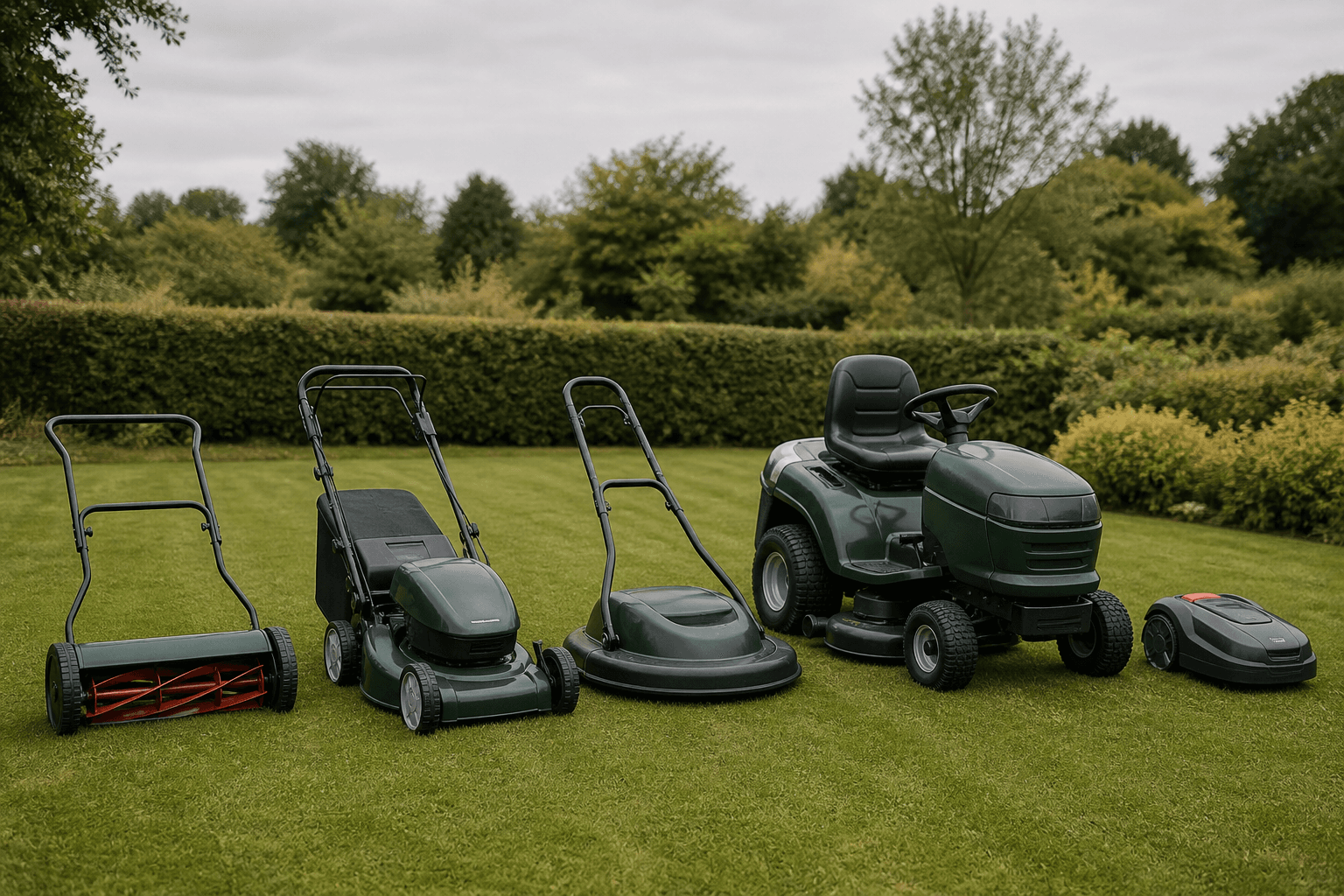
Lawn mowers fall into five broad categories - cylinder, rotary, hover, ride-on and robotic - and the right choice depends on lawn size, terrain, the finish required and, for trade users, the safety obligations that come with operating powered machinery in a working environment. Understanding the differences before hiring or buying saves time, reduces risk and protects the quality of the turf.
Cylinder Mowers
A cylinder mower uses a rotating set of helical blades that cut against a fixed bottom blade in a scissor action. This produces one of the cleanest cuts available and is the preferred choice for formal lawns, bowling greens and high-quality domestic turf where a precise, low finish is required. Because the cutting action is gentle, it causes less tearing of the grass leaf, which reduces the risk of disease entry.
Cylinder mowers perform best on flat, already well-maintained grass. They struggle with long, thick or uneven growth, and are not suited to rough or undulating ground. They are available in hand-push, electric and petrol-powered versions, so the right power source can be matched to the size of the area.
For domestic gardens, a hand-push cylinder mower is a practical, low-noise option that suits small, flat lawns. Powered cylinder mowers are the standard tool for groundskeepers maintaining sports surfaces and formal estates.
Rotary Mowers
Rotary mowers are the most widely used type in the United Kingdom. A single horizontal blade spins at high speed beneath a deck, cutting grass by impact rather than by the scissor action of a cylinder machine. This makes them far more tolerant of longer, coarser and uneven grass, and they can handle a wider range of lawn conditions.
Rotary mowers are available as corded electric, cordless battery and petrol models. Corded electric machines are suited to smaller gardens with straightforward access to a power supply. Cordless battery models offer more freedom of movement and are a practical choice for medium-sized gardens. Petrol rotary mowers deliver the most power and are the standard choice for larger gardens, commercial grounds maintenance work and situations where a mains supply is not available.
Self-propelled rotary models, where the rear wheels are driven by the engine, reduce operator effort on larger plots and are widely used by professional landscaping teams. A rear roller fitted to a rotary mower produces the stripe effect on a lawn by laying the cut grass in alternate directions.
Because the blade rotates at high speed, objects on the lawn - stones, wire, children's toys - can be ejected at serious velocity. The area to be mown should be checked and cleared before work begins.
Hover Mowers
A hover mower is a rotary machine that floats on a cushion of air generated by the rotating blade. With no fixed wheel contact with the ground, it can be swung freely in any direction, making it well suited to awkwardly shaped lawns, areas with tight edges and, with care, gentle slopes. Some models are specifically adapted for work on steeper banks.
Hover mowers are generally lighter than equivalent wheeled rotary machines, which makes them less tiring on areas that require a lot of directional change. They are available in corded electric and cordless battery versions. Petrol-powered hover mowers also exist and are used in grounds maintenance work where a mains supply is not practical.
The hover principle makes the machine less stable on very uneven ground, and on steeper slopes the operator should always work across the slope rather than up and down it.
Ride-On Mowers
Ride-on mowers are designed for large areas where walking behind a pedestrian machine would be impractical. The operator sits on the machine, which is powered by a petrol or diesel engine driving a wide cutting deck beneath the chassis. Cutting deck widths vary considerably, and a wider deck covers ground faster over the same area - a relevant factor for professional grounds maintenance firms managing large open spaces.
Ride-on machines divide broadly into lawn tractors, out-front mowers and zero-turn mowers. Lawn tractors have the cutting deck mounted beneath the machine between the axles. Zero-turn mowers have independent rear-wheel motors that allow the machine to spin on its own axis, giving tight manoeuvrability around obstacles. Out-front mowers carry the deck ahead of the front wheels and are commonly used in grounds maintenance for roadside verges and amenity areas.
Safety obligations for ride-on machines are more demanding than for pedestrian models. The HSE has made clear in enforcement action that employers must carry out a suitable and sufficient site-specific risk assessment before ride-on mower operations begin, particularly when working on slopes or near water. A roll-over protection system (ROPS) is a critical safety feature on ride-on machines operating on uneven or sloping ground, and the HSE has confirmed that removing a ROPS exposes operators to serious risk of fatal injury. Employers must ensure that equipment is appropriate for the terrain and fitted with the necessary safety features to protect operators.
The British Association of Landscape Industries (BALI) has published a Guidance Document for the Landscape Industry that sets out the measures employers should take to assess and control risks when working on or near slopes and banks. HSE enforcement action has referenced this document as the applicable industry standard.
Practical checklist before operating a ride-on mower on site:
- Complete a written, site-specific risk assessment before work starts
- Confirm that the ROPS is fitted and undamaged
- Check that the operator-presence switch stops the blades immediately on release
- Clear the area of surface debris - stones, wire and similar objects
- Identify all slopes, banks and water features on the route
- Ensure the operator has received appropriate instruction and training
- Keep bystanders clear of the working area
Robotic Mowers
Robotic mowers operate autonomously within a defined boundary, cutting small amounts of grass on a frequent or continuous basis. Because they work incrementally, the fine clippings they produce are returned to the lawn as a natural mulch rather than collected. This reduces maintenance time significantly and eliminates the need for a collection box.
Robotic mowers are powered by rechargeable batteries and return automatically to a docking station to recharge. They are quiet in operation compared with petrol machines, which makes them appropriate for residential settings with noise-sensitive neighbours. The perimeter wire or GPS boundary system must be installed correctly for the machine to operate safely and stay within the intended area.
For professional grounds maintenance companies taking on larger or more complex sites, commercial-grade robotic mowers are available with greater range, slope tolerance and obstacle-detection capability than domestic models. A trade services listing can help site managers find contractors with the appropriate equipment for larger robotic mowing installations.
Safety and Legal Obligations for Trade Users
Whether operating a pedestrian push mower or a large ride-on machine, trade users in the UK have specific legal duties. The Health and Safety Executive (HSE) is Britain's national regulator for workplace health and safety, and its guidance covers mowing operations in both agricultural and grounds maintenance contexts.
These hazards apply equally in grounds maintenance contexts.
Landscaping businesses operating in London or the surrounding area can find professional contractors through listings such as landscaping services in London, landscaping services in Bromley and landscaping services in East London, making it straightforward to find firms with the right equipment and compliance knowledge for the job.
Choosing the Right Type
The decision comes down to four practical factors: lawn size, terrain, required finish and whether the work is commercial or domestic.
- Small, flat, formal lawn: cylinder mower - hand-push or electric
- Small to medium garden with mixed conditions: corded or cordless electric rotary mower
- Awkward shapes, banks or slopes: hover mower
- Medium to large garden, coarser grass: petrol rotary mower, self-propelled if the area is large
- Large grounds, commercial maintenance: petrol ride-on or out-front mower with full risk assessment and ROPS confirmed in place
- Automated maintenance with minimal operator input: robotic mower
Power source affects running cost, noise, maintenance requirements and environmental impact. Petrol machines offer the most power and range but require fuel storage, regular oil checks and engine servicing. Battery machines are quieter and lower-maintenance but their running time per charge is finite. Corded electric machines are consistent but their reach is limited by cable length and they require a safe outdoor power supply.
Whatever type is selected, the cutting height should always be adjusted to suit current grass length. Cutting more than one third of the grass blade in a single pass stresses the turf and is a common cause of poor results.
GetBrent makes it straightforward to find local hire companies, plant and tool suppliers, and professional grounds maintenance firms. Whether you need a mower for a one-off job or are looking for a landscaping contractor to manage an ongoing site, browsing GetBrent's local listings is the quickest way to find the right equipment or the right team.