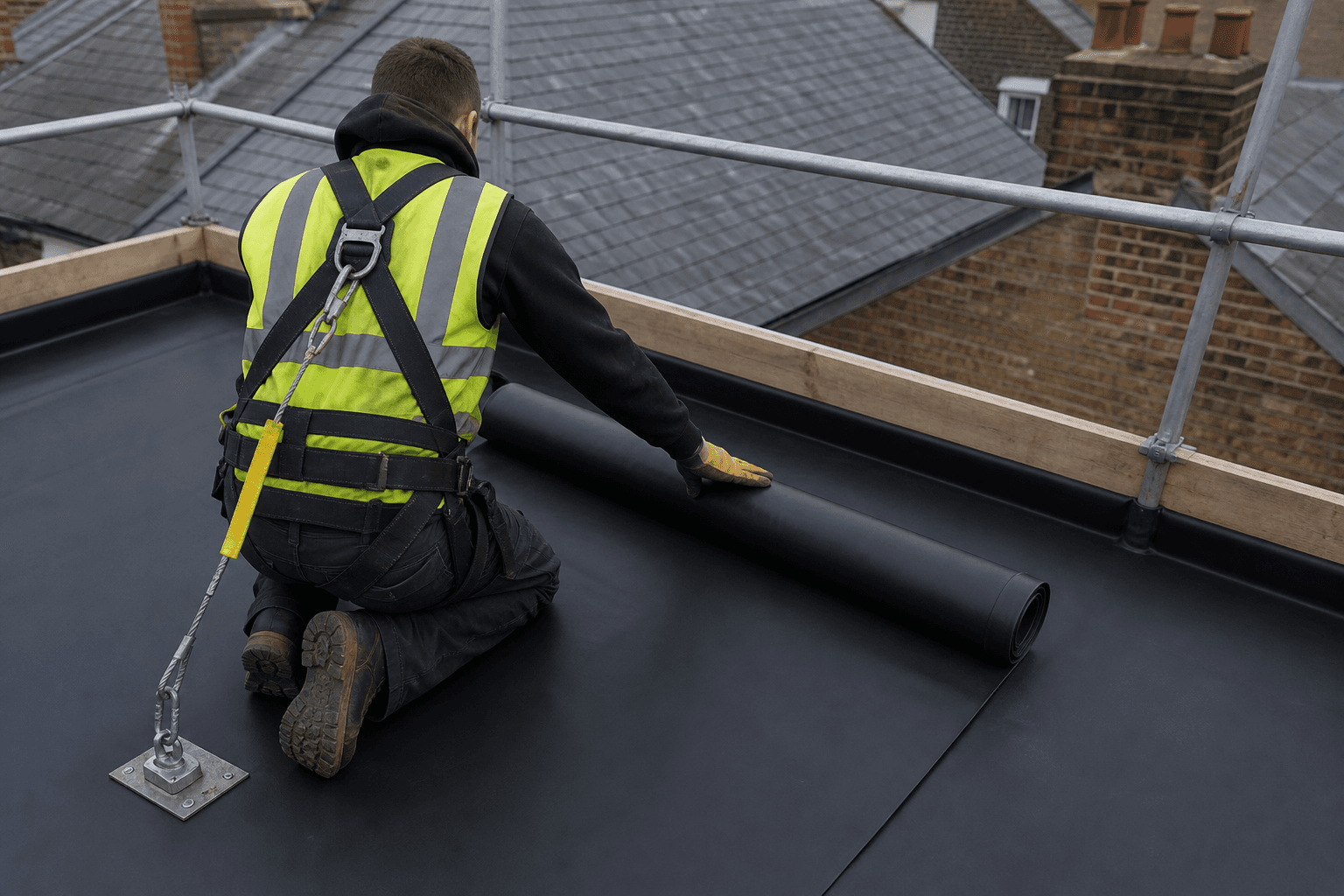
The HSE and legislation.gov.uk pages used for this article do not rank felt, EPDM and GRP against one another, so the membrane should be chosen only after the work at height has been planned. Whichever system is fitted, the Work at Height Regulations 2005 apply to the job, and the risk controls come first.
Why the membrane comes second
HSE names falls from ladders and through fragile roofs among the common causes of falls from height. It also reports that work at height is the most significant source of fatal and serious injury in construction, with smaller projects particularly exposed.
HSE explains that they apply where there is a risk of a fall liable to cause personal injury. They place duties on employers and on anyone who controls work at height, including facilities managers and building owners who contract others to do it.
HSE also notes that a working platform can be virtually any surface from which work is carried out, and lists a roof among its examples. A flat roof therefore falls within that definition, and the size of the job does not decide whether the Regulations apply.
The order you must follow
The law requires employers and self-employed contractors to assess the risk from work at height, then organise and plan the work so it is carried out safely. HSE asks you to try avoiding work at height if you can. Where avoidance is not possible, you must otherwise prevent or arrest a fall and injury, and HSE's hierarchy then covers measures that minimise the distance and consequences of a fall.
The order matters. HSE's hierarchy must be followed systematically, and a lower level is only considered when the level above is not reasonably practicable. HSE gives a flat roof with permanent edge protection as an example of an existing safe place of work that prevents falls without added equipment. Before any membrane is specified, check the edges first, because that example depends on them.
HSE's FAQ says the Regulations also place duties on those who control work at height, such as building owners who contract others to do it.
What to check before work starts
Two regulations are directly relevant to roof work. Regulation 9 of the Work at Height Regulations 2005 covers fragile surfaces, and regulation 13 covers inspection of places of work at height, according to the contents listing on legislation.gov.uk. HSE's FAQ adds that the Regulations require the risks of working on or near fragile surfaces to be properly managed.
Use the following checklist when a firm proposes a membrane:
- Confirm who controls the work and whether any part of it is being contracted out, since that person carries duties under the Regulations.
- Ask for the written risk assessment, which employers and self-employed contractors must carry out before the work is organised and planned.
- Ask how the risks of working on or near fragile surfaces will be managed.
- Ask how the place of work will be inspected, and how any access equipment is inspected and maintained.
- Check that the people doing the work are competent and that the work is planned and organised.
- Ask what edge protection or safe access is included in the quote, and what is left to you to provide.
Practical tip: put these questions to every firm in writing. A firm that can answer them clearly is easier to compare than one that offers only a product name.
Comparing quotes like for like
A membrane name does not tell you what a quote covers. Two quotes for the same membrane can differ because one includes edge protection, safe access and inspection, while the other leaves them out. Compare line by line against the checklist above rather than the headline figure.
Ask each firm to itemise what its price includes, such as access, edge protection and inspection. The figure itself should be confirmed with the company doing the work, because it varies between firms and between jobs.
What this article does not cover
The HSE and legislation.gov.uk pages used here do not address the expected lifespan, installed cost or thermal performance of felt, EPDM or GRP. Those points have been left out rather than estimated. For them, ask each installer for written product information and check it against the points above before you agree a job.
To find local firms, use GetBrent to browse trade services on the marketplace, or narrow the search to trade services in London.