A house clearance is the removal of some or all of a home's contents, with the team sorting everything into items to keep, donate, recycle or dispose of. This guide covers England, where the rules below apply. In England, the Environment Agency is the regulator for the duty of care, and the pages describe the rules for England and Wales; Scotland and Northern Ireland have their own codes.
Before the day: preparation that saves time
Most of the work on the day goes more smoothly if the property has been prepared in advance. Valuables, antiques, photographs and items with sentimental value should be removed first, and any significant documents mixed in with other belongings need to be found and set aside. Anything that could be of value found during the clearance should be kept separate and returned to you once the process is complete.
Clearing a home after a death can involve more than possessions. Citizens Advice guidance on dealing with a person's financial affairs makes the point that the estate includes property, possessions, money and debts, so the personal representative needs to understand all of them before final distribution. If you are dealing with an estate, look at the paperwork before the team takes anything away. If the property is large, heavily cluttered, or the will is disputed, it may be sensible to ask for support from relatives, solicitors, clearance companies or local charities.
If you are clearing a home for a family member or a property you have been asked to empty, a house clearance service in London or a house clearance service in Sheffield can be arranged in the same way as anywhere else. Check the scope with the firm before booking so that the items to be removed are agreed in advance.
On the day: what usually happens
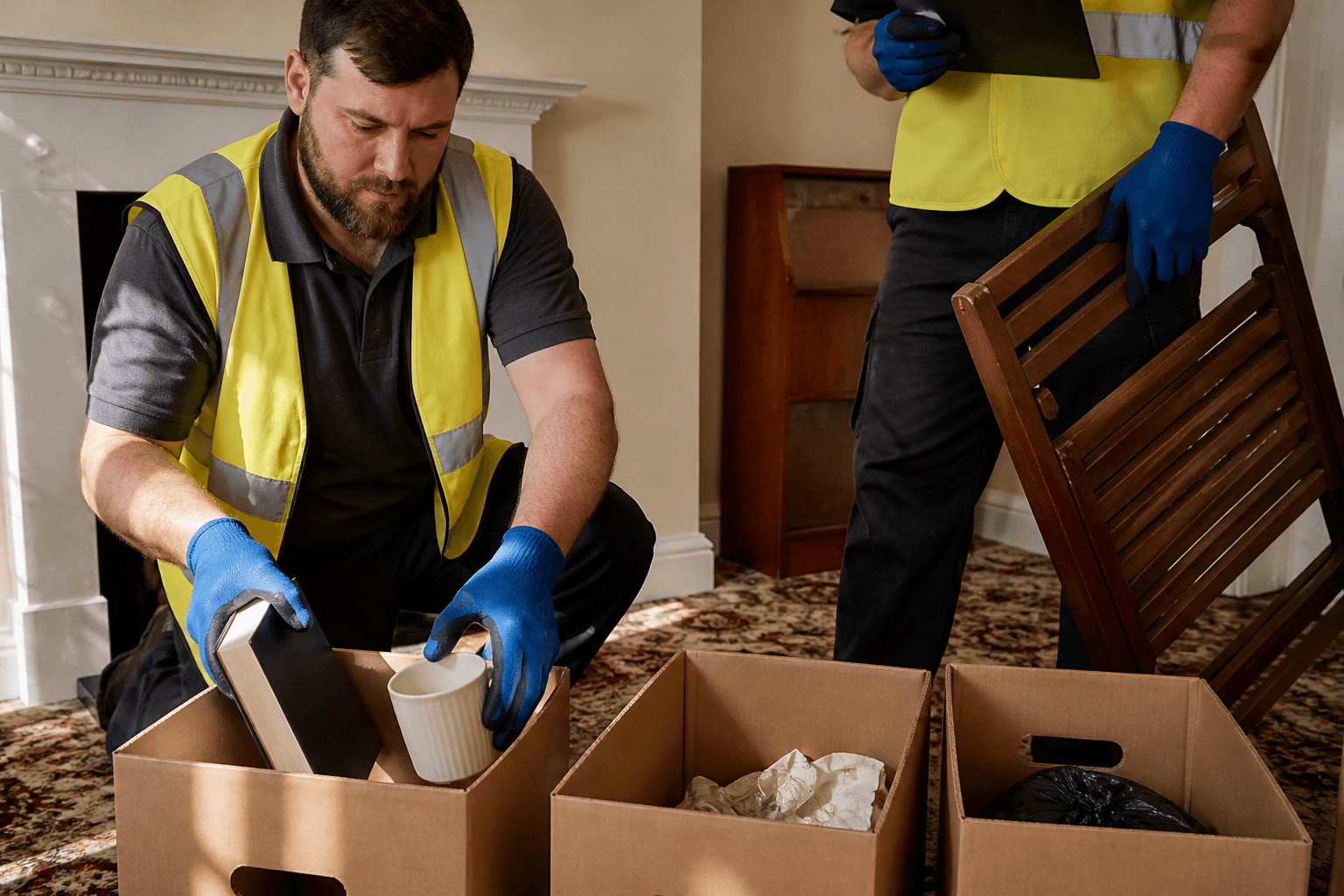
Clearance teams typically arrive at the scheduled time and remove items according to your instructions. They usually work room by room and separate items for donation, auction, recycling or disposal. The length of the job depends on the size of the property, so a small one-bedroom flat may be cleared in a short time while a larger house takes much longer. Some firms also secure the area first so that the work can proceed safely.
You do not have to stay for the whole job. Some householders prefer to oversee the work, while others prefer to leave the team to get on with it. Either way, agree in advance which items are to be kept, which are for charity, and which are to be thrown away, and put a clear label or a note on anything you want to keep.
- Set aside items you want to keep, plus any documents, valuables and keys.
- Label anything that must not be removed, and tell the team before they start.
- Confirm the time, the access arrangements and who will be on site.
- Ask what will happen to the items, including whether any will go to charity.
- Check the property is accessible, including parking for the vehicle.
Waste duty of care: what the law expects of you
The householder duty of care applies to occupiers of domestic property in England and Wales. The Environment Agency is the regulator for the duty of care in England, and Natural Resources Wales in Wales. The Waste Duty of Care Code of Practice states that the householder has a separate duty of care that is limited to taking all reasonable measures available to them to ensure their waste is only transferred to an authorised person. This is set out under section 34 of the Environmental Protection Act 1990.
The code also explains that when a householder uses a private business to take their waste, such as a skip hire firm or a house clearance company, the householder should check that the firm is an authorised carrier with an up to date and valid upper tier registration.
Failing to comply with the duty of care is an offence with no upper limit on the courts' power to fine. Keep any paperwork the firm provides.
Checking the firm before it takes anything away
The practical step is to check the carrier before work starts. Ask the firm for its business name and waste carrier registration number, then search the Environment Agency public register. The Environment Agency public register lets you search for waste carriers, brokers and dealers by business name or registration number. Confirm the entry matches the company you are dealing with and that the registration is current.
Ask where the waste will end up. The code says you should check that the next waste holder is authorised to take the waste, and ask where they will take it. A reputable firm should be able to tell you which transfer station or recycling route its waste goes to, and should provide a receipt or waste transfer note afterwards.
- Ask for the firm's waste carrier registration number and registered name.
- Search the Environment Agency public register and confirm the registration is current.
- Ask where the waste and any reusable items will go.
- Ask for a waste transfer note or receipt after the clearance.
- Keep the paperwork with your property records.
The rules on waste carriers, brokers and dealers are being reformed, with registrations to be replaced by standard rules permits or registered exemptions. GOV.UK states that waste carrier, broker and dealer registrations are being replaced with a standard rules environmental permit or a registered exemption, so check the register again if you are arranging clearance some time from now.
Cost: what drives the figure
The price of a clearance depends on factors that the firm will assess when it quotes. The main drivers are the volume of items, the size of the property, the amount of access work, any specialist waste such as electrical items or garden waste, and the distance to the disposal point. Additional services such as cleaning or minor repairs will also change the figure.
For a house clearance across the wider country, you can also look at clearance and disposal companies on GetBrent to compare what each firm offers. If you need a specific area covered, a local house clearance listing can help you find firms that work in your postcode.
GetBrent.co.uk lists local hire companies for trailers, tools, plant, vans, storage, removals, clearance and trades. Use the directory to find a clearance firm near you, then check its waste carrier registration on the Environment Agency public register before you book.