
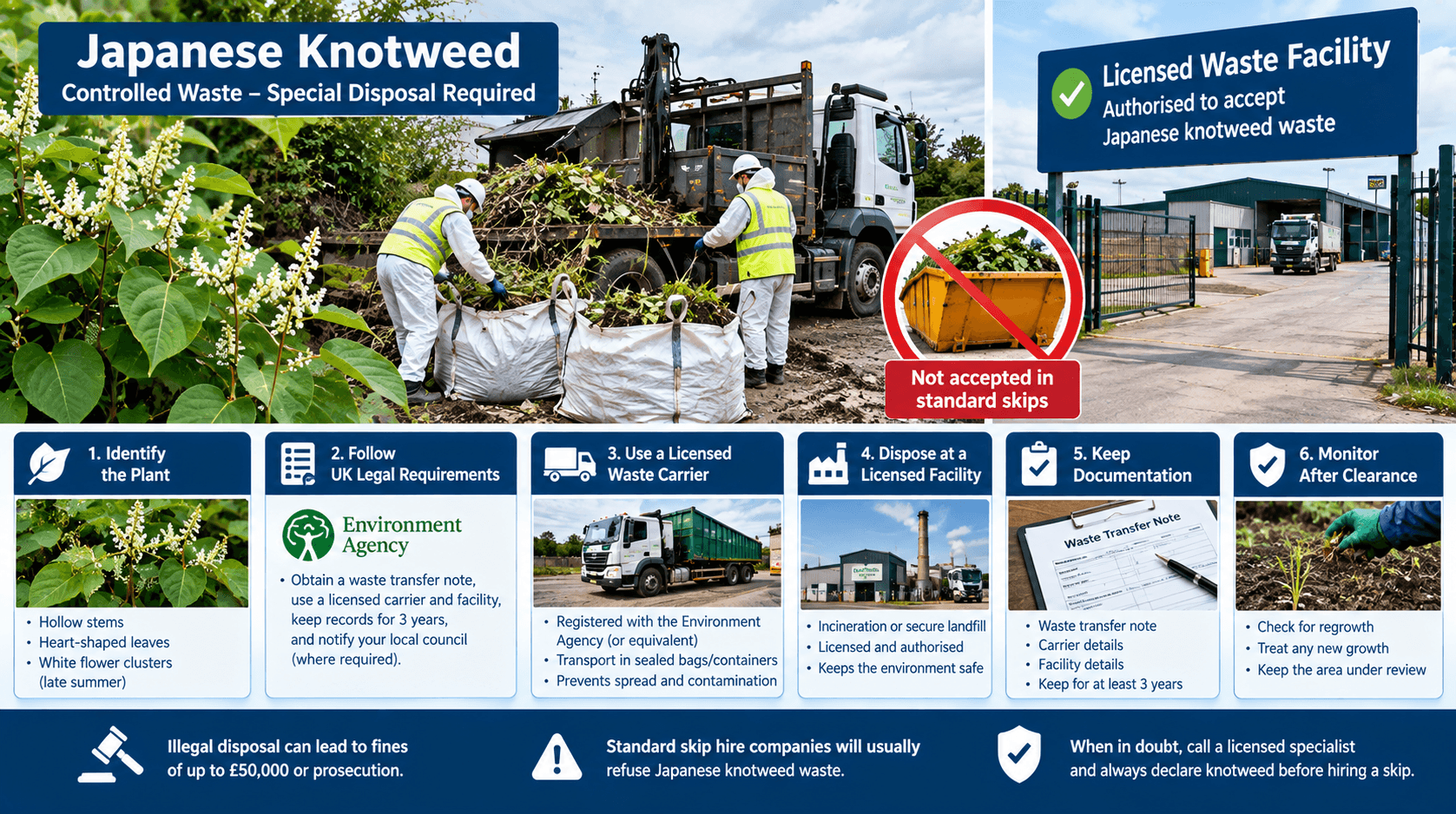
Japanese knotweed is classified as controlled waste under UK environmental law, which means it cannot be disposed of through ordinary waste streams or standard skip hire. Property owners and contractors who fail to follow the correct disposal procedure face enforcement action from the Environment Agency or local council, along with potential fines. Understanding the rules is essential before beginning any clearance work.
Why Japanese Knotweed Requires Special Disposal
Japanese knotweed is an invasive non-native plant species that spreads rapidly and causes significant damage to buildings, roads, and natural habitats. Because of its destructive potential, the Environment Agency and local councils treat it as a controlled waste material rather than ordinary garden waste. This classification means it must be tracked, transported, and processed in a way that prevents it from escaping into the environment.
The plant's rhizomes (root systems) can survive in soil and regrow from tiny fragments. Even small pieces of stem or root left in standard garden waste or compost can establish new infestations elsewhere. For this reason, any soil or material contaminated with knotweed must be sent to a licensed waste facility that can either incinerate it or safely contain it in a secure landfill.
UK Legal Requirements for Disposal
Under Environmental Protection Act 1990 and the Environmental Damage Regulations, anyone undertaking Japanese knotweed removal must ensure waste is disposed of at an authorised facility. The Environment Agency maintains a register of licensed waste sites across England, and equivalent oversight applies in Scotland (SEPA), Wales, and Northern Ireland through their respective environmental bodies.
Before any clearance begins, the property owner or contractor must:
- Obtain a waste transfer note or consignment note from the licensed waste facility
- Document the source, type, and volume of contaminated material
- Ensure the waste carrier is registered with the Environment Agency (or equivalent body)
- Keep records for at least three years
- Notify the local council of the infestation (in some areas this is mandatory)
Failure to use a licensed facility, or disposing of knotweed in a standard skip, constitutes illegal waste disposal and can result in prosecution, fines up to £50,000, or both.
What Standard Skip Hire Companies Will and Won't Accept
Most skip hire operators explicitly refuse Japanese knotweed waste because accepting it would require them to hold a waste management licence. When hiring a skip for garden clearance, it is vital to confirm with the supplier that the site is free of knotweed before the skip is delivered. If knotweed is discovered during clearance, the skip operator may refuse to collect the load, or they may charge additional fees to handle it as hazardous waste.
For this reason, professional Japanese knotweed removal contractors are often the safest route. These specialists have the proper licensing, equipment, and connections to licensed disposal facilities. When obtaining quotes or arranging clearance and disposal services, always ask whether the contractor is licensed to handle controlled waste and which facility they use for disposal.
Steps to Follow Before and During Clearance
The process differs depending on whether the infestation is small and contained, or large and widespread. In either case, careful planning is essential.
- Identify and survey the site. Confirm the extent of the knotweed. Japanese knotweed is identifiable by its hollow stems, heart-shaped leaves, and clusters of small white flowers in late summer. If uncertain, ask a specialist to survey the site.
- Check local council requirements. Some councils require notification of Japanese knotweed on residential property. Contact the environmental health or planning department to confirm local rules.
- Source a licensed waste facility. Contact the Environment Agency's waste facility register or ask the clearance contractor which licensed site they will use. Confirm they are authorised to accept knotweed waste.
- Arrange appropriate transport. Contaminated soil and plant material must be transported in sealed bags or containers to prevent spread. The waste carrier must be registered.
- Obtain documentation. Request a waste transfer note or consignment note from the facility and keep it with your records.
- Plan post-clearance monitoring. After removal, monitor the site regularly for regrowth, as knotweed can regenerate from small root fragments left in soil.
When to Call in Professionals
For larger infestations or properties in densely populated areas such as garden clearance in London, professional contractors are strongly recommended. They understand local authority requirements, hold the necessary waste licences, and have experience preventing contamination of surrounding land. They also carry specialist insurance, which protects the property owner if something goes wrong.
When hiring equipment or skip services from GetBrent for general garden clearance, always declare any Japanese knotweed present on site beforehand. This ensures the right specialist is arranged and avoids costly delays or refusals on the day.
Japanese knotweed disposal is not optional or negotiable—it is a legal obligation enforced by local councils and the Environment Agency. Property owners who clear it themselves must follow the same rules as contractors. If you are planning clearance work and suspect Japanese knotweed is present, consult a licensed specialist first, then use GetBrent to find local hire companies that can supply equipment for the safe disposal and restoration of the site.