For most roof access jobs in Great Britain, the choice is between a tower scaffold, a fixed or system scaffold, and a mobile elevating work platform (MEWP), often called a cherry picker. Ladders are the option of last resort for longer work. The governing rules come from the Work at Height Regulations 2005, which apply across Great Britain.
Start with the legal duty, not the equipment
The starting point is the duty to plan. The regulations require that work at height is properly planned and organised. HSE guidance says that when working at height you must also plan for emergencies and rescue.
Before any equipment is chosen, the regulations set an order of priority. Employers must ensure that work is not carried out at height where it is reasonably practicable to do the work safely otherwise. Where work at height cannot be avoided, employers must take suitable and sufficient measures to prevent, so far as is reasonably practicable, any person falling a distance liable to cause personal injury.
HSE guidance advises not to go on a roof in poor weather such as rain, ice, frost or strong winds. That matters for any roof job, because wind and rain change the risk of every option below.
Choosing between tower, scaffold and cherry picker
When selecting work equipment, the Work at Height Regulations 2005 require employers to give collective protection measures priority over personal protection measures. The selection must also take account of the working conditions, the distance to be negotiated for access, the distance and consequences of a potential fall, and how long and how often the equipment will be used.
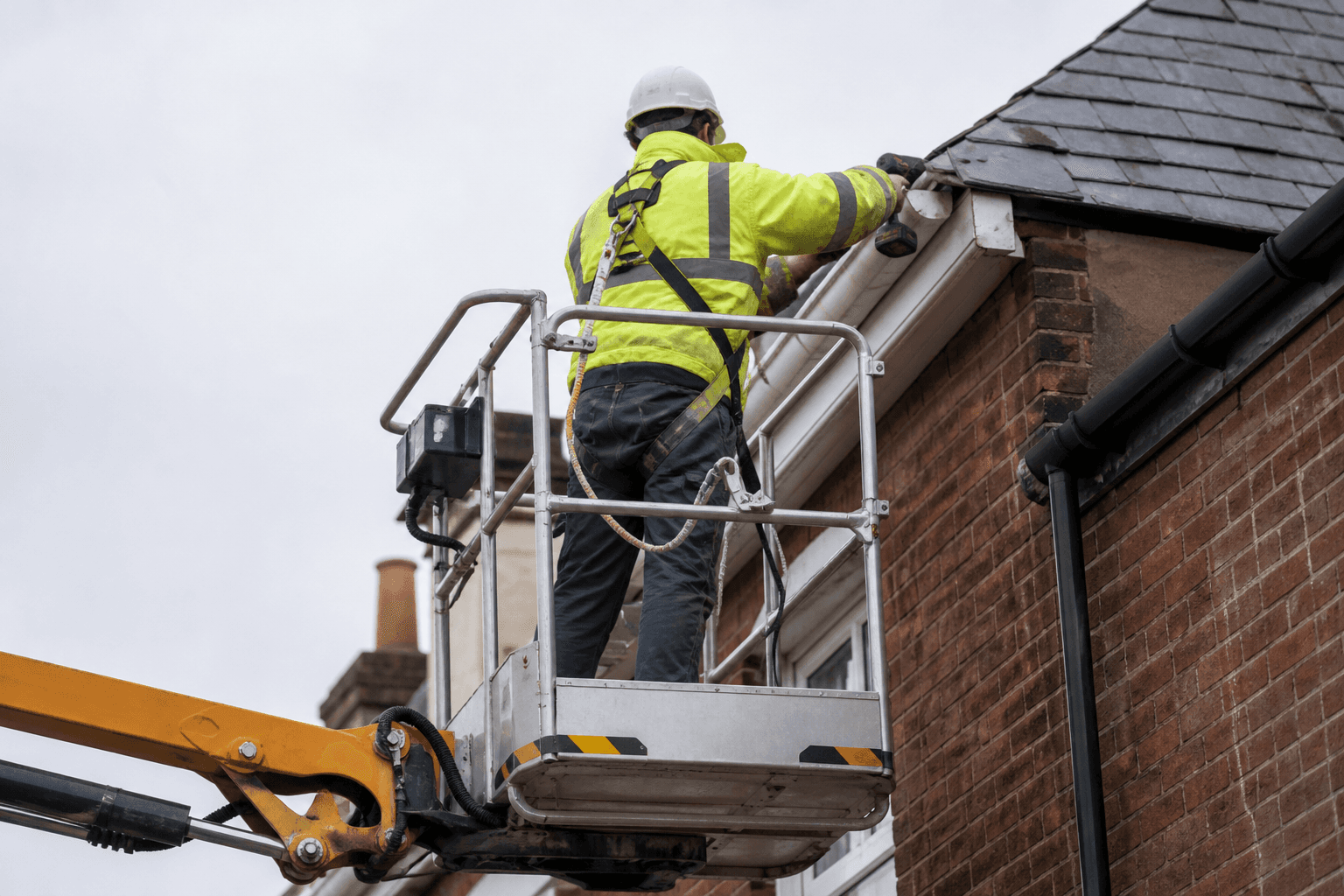
HSE guidance on roof work advises this order. Where work is possible from underneath the roof, HSE advises using a suitable work platform. Where that is not possible, HSE advises using a mobile elevating work platform that lets people work from within the basket without having to stand on the roof.
In practice, the three main options compare as follows:
- Tower scaffold: suited to work at a fixed height where the base can be placed on firm ground. HSE guidance says anyone erecting a tower scaffold should be competent and trained under an industry recognised scheme, and that the manufacturer's instructions must be followed for maximum height.
- Scaffold (fixed or system): suited to longer jobs and heavier work. HSE guidance says a scaffold must either be erected to a recognised standard configuration or designed by calculation to ensure it has adequate strength and stability.
- Cherry picker (MEWP): suited to reaching an edge or a section of roof from a basket, without the operator standing on the roof. It is used where the ground conditions and access allow it to be positioned safely.
Ladders are the least preferred option. HSE guidance says ladders can be used for low-risk, short duration work, and where a risk assessment shows other more suitable work equipment cannot be used due to the layout of the work area. HSE guidance says ladders are a last resort and should only be used for low risk, short duration work. Where a ladder is used, it must be secured so it cannot slip, and HSE states there is no maximum height for using a ladder.
Practical checks before you start
Whichever equipment you choose, the regulations require that it is inspected. A scaffold used for construction should be inspected before it is used for the first time and then every 7 days, until it is removed. A scaffold should also be inspected each time it is exposed to conditions likely to cause deterioration, such as adverse weather.
Use this checklist before any roof access job:
- Confirm that the task cannot reasonably be done from ground level or from an existing place of work.
- Record the risk assessment and the reasons for the equipment chosen, including why a ladder is or is not justified.
- Check that the people erecting, operating or supervising the equipment are competent, or are being supervised by a competent person while they train.
- Confirm the ground is firm and level, and that any wheeled structure can be prevented from moving inadvertently while in use.
- Check the weather before starting, and stop if conditions could jeopardise safety.
- Plan for emergencies and rescue, including how someone would be brought down from the platform or roof.
- Stop material and tool falls by storing them so they cannot collapse, overturn or move unexpectedly, and by taking steps to prevent objects falling onto people below.
Who needs to be competent
HSE guidance says those involved in work at height must be competent, and that those being trained must be supervised by a competent person. That applies whether you hire a firm or do the work in-house, so check the competence of the people you engage before the job starts.
When hiring equipment or a firm, ask who will erect the tower or scaffold, who will operate the cherry picker, and how they are trained. Ask for evidence of training and for inspection records, and confirm these details in writing.
For roof work close to the edge, the regulations also require measures against falls and falling objects. If you are arranging roof access for a project, roofing and access firms in London or access equipment hire in Birmingham can help you compare options locally.
Where the rules differ across the UK
The Work at Height Regulations 2005 apply across Great Britain, and the legislation pages reviewed here cover that framework. This article has not verified the position in Northern Ireland, where separate health and safety rules apply, so check the local equivalent before work starts there.
If you are unsure which equipment suits your roof, or which firm can supply and operate it safely, start with a search for trade services in the 7GU area to narrow down local suppliers, then confirm the competence, inspection records and any quoted figures directly with each company.
GetBrent helps you find local hire companies for tower scaffolds, access platforms and trades firms across the UK. Browse listings, compare what each firm offers, and ask the questions in this guide before you book roof access for your job.