For private sellers, the practical result is simple: take proof of your name and address, expect to be paid by bank transfer or cheque, and sell only to a dealer who holds a valid licence.
Who the Act applies to and where
The Act applies in England and Wales. The Scrap Metal Dealers Act 2013 applies in England and Wales and was commenced on 1 October 2013. The Act extends to England and Wales only, so it does not cover Scotland or Northern Ireland.
The Act is aimed at the businesses that handle scrap. A private individual who sells their own unwanted scrap is not the target of the licensing regime. You do not need your own scrap metal dealer's licence simply to sell unwanted household, vehicle or business scrap to a licensed scrapyard.
What a licensed dealer must do
The licence is issued by the local council. You must hold either a site or mobile collector's licence, issued by the council, if you're a scrap metal dealer in England and Wales. A site licence covers fixed premises, while a collector's licence covers door-to-door work. A collectors licence will allow you to collect scrap only within the authority area that it was issued.
Once licensed, the dealer's details go on a national list. The Environment Agency must maintain a register of scrap metal licences issued by authorities in England. Wales has its own equivalent, since the Natural Resources Body for Wales must maintain a register of scrap metal licences issued by authorities in Wales. You can check a dealer against these records before you travel.
What you will be asked for when you sell
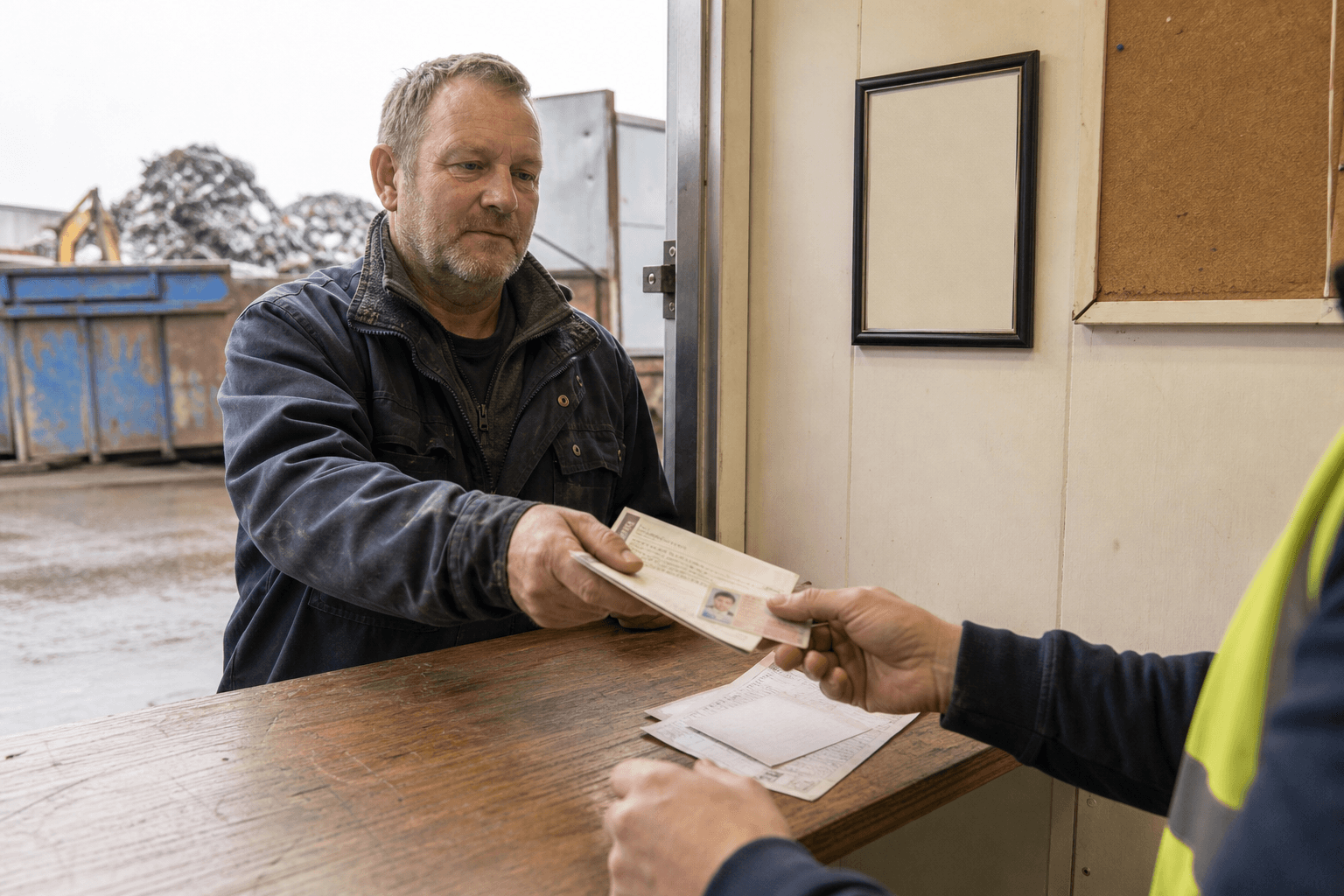
The identity check is the rule sellers meet most often. You must not receive scrap metal from a person without verifying their name and address. A dealer must not receive scrap metal from a person without verifying their full name and address by reference to documents, data or information from a reliable and independent source. Where a dealer cannot confirm your details, the sale should not go ahead.
Your vehicle may also be recorded. Records must include a description including type, form, condition, weight, any marks identifying previous owners or distinguishing features, the date and time, and the registration mark of the vehicle it was delivered in or on. Dealers must keep their records for 3 years. You must keep your records for 3 years and allow the council or police to inspect your premises and records if asked.
Practical checklist before you go:
- Take a passport or photocard driving licence that shows your name and address.
- If you have no photocard, take a document that proves your address, such as a utility bill or bank statement.
- Sort the metal by type and remove only parts you can take off safely.
- Confirm that the dealer holds a current council licence before you travel.
- Ask how you will be paid, and only accept bank transfer or cheque.
The cash payment ban
This is the rule that catches people out. You must not buy scrap metal for cash. If a dealer offers cash, that is a warning sign. A scrap metal dealer must not pay for scrap metal except by a non-transferable cheque or by an electronic transfer of funds. Where a dealer makes a payment, the record must also show who made it. If payment is made, the record must include the full name of the person who makes the payment acting for the dealer.
What drives the cost of clearing scrap
Whether you sell scrap or pay someone to remove it, the figure depends on factors that vary from case to case. For a sale, the amount you receive depends on the type and weight of metal, and on any deductions a dealer applies. For a clearance job, the cost is driven by the volume and type of waste, how far it must be carried, and whether the work needs a licensed carrier. Councils do not publish these figures consistently, and rates vary by depot, so you should confirm any price directly with the dealer, collector or council before you agree to anything.
If you are clearing a property or site and need to dispose of mixed waste as well as metal, a licensed carrier is required in most cases. If you transport scrap metal you will in most cases require a Waste Carriers Licence from the Environment Agency. Ask any firm you use to show that it holds the relevant permit.
If you are looking for a firm to help with a larger job, you can browse clearance and disposal services on GetBrent. If you are based in the capital, scrap metal collection in London may be a useful place to start, and for a more local search, scrap metal dealers in Wembley or scrap metal services in Acton can help you compare options near you.
Quick reference
The rules come down to three points. The dealer must be licensed by the council. The dealer must check your name and address and record the sale. The payment must not be cash. If any of these is missing, walk away and contact the council that issued the dealer's licence.
Find a licensed local scrap metal dealer or collector through GetBrent, and check their licence and payment method before you agree to a sale or a clearance job.