Only small amounts of petrol can be kept in England, Wales and Scotland without notifying anyone, and only in suitable portable containers. The Petroleum (Consolidation) Regulations 2014 cover non-workplace premises storing petrol, for example private homes or clubs, and they replace all previous petrol storage legislation. The pages used for this article do not address self storage units directly, so the checks below apply to any unit you are considering.
Why petrol is regulated
The Health and Safety Executive (HSE) explains that there is always a risk of a fire and/or an explosion if there is a source of ignition nearby, for example a naked flame, an electrical spark or similar. Its general advice is to avoid keeping petrol unless it is genuinely needed.
How much petrol the rules allow
The regulations set a 30 litre limit for non-workplace premises. Up to 30 litres may be kept without informing the Petroleum Enforcement Authority, provided it is held in suitable portable containers or a single demountable fuel tank. Any petrol contained in a fuel tank that is connected to an internal combustion engine in the way it would ordinarily be connected when the engine is running is not to be counted towards the total. That means fuel in the tank of a vehicle or machine does not add to your total, but spare cans do.
Larger quantities fall under further requirements, including notification, set out in the same regulations. Check the figure you intend to keep at any one time, not the amount you typically use in a month.
Containers that count
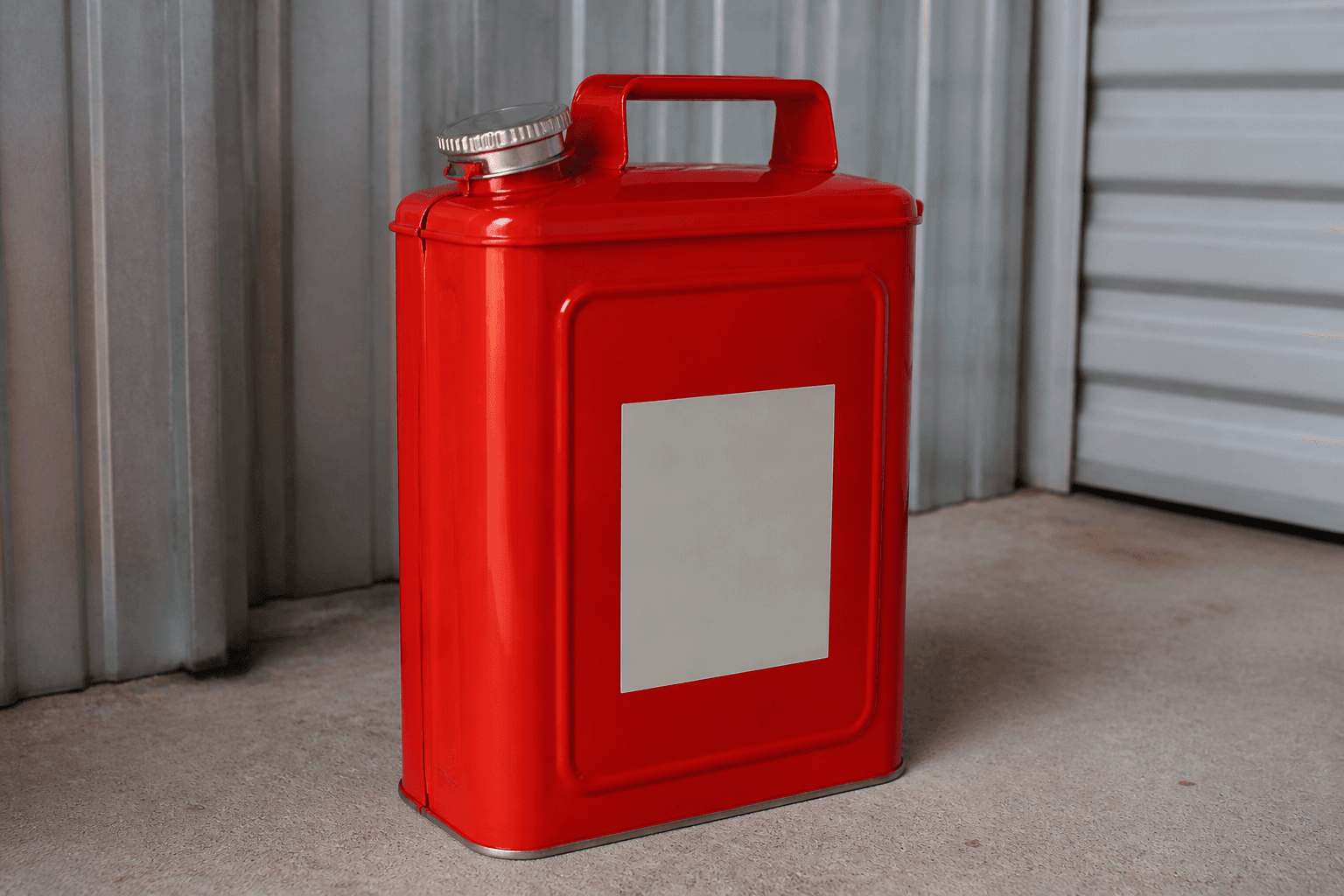
The HSE's container guidance sets size limits. Plastic containers may have a nominal capacity no greater than 10 litres, and metal containers no greater than 20 litres. The same guidance requires that containers are marked or labelled in a legible and indelible form with the words 'PETROL' and 'HIGHLY FLAMMABLE' , along with a hazard warning sign and the nominal capacity in litres.
Checklist before you store any fuel
- Add up every spare container you plan to keep, and stay within 30 litres unless you have notified the local Petroleum Enforcement Authority.
- Use only containers designed for petrol, with the right markings and a capacity within the limits above.
- Keep the cap of each container securely fastened .
- Keep fuel out of direct sunlight and out of the reach of children .
- Treat empty containers with care, since fumes which can remain in the container can still be dangerous.
- Never take petrol into any house, flat or anywhere where people live .
- Ask the storage operator in writing whether fuel is allowed before you book, and get the answer in your contract.
Where to go next
If you are deciding where to keep fuel-powered equipment, it helps to check the operator's terms first and the local regulator second. If you are also comparing storage options, you can compare self storage in London or browse the wider self storage category listings on GetBrent.