Before you dig, you should plan the work, locate and identify any buried services, and only then excavate, following the three basic elements of a safe system of work set out in the Health and Safety Executive's guidance HSG47, Avoiding danger from underground services. The guidance is aimed at everyone involved in commissioning, planning, managing and carrying out work on or near underground services, and it is also useful to the owners and operators of those services. The guidance applies to work in Great Britain.
Why underground services are a serious hazard
Buried cables, gas pipes, water mains and drainage can be damaged by excavation, and the consequences are severe. Damage to underground services can cause fatal or severe injury. It can also delay the work and cost money. The HSE guidance explains the direct risks to people's health and safety and the indirect risks that arise when services are damaged.
The HSE also notes that plans give only an indication of the location, and number of underground services at a particular site. This is why a plan on its own is never a substitute for checking the ground on site.
Step one: plan the work and gather information
The first stage of a safe system of work is planning. Plans or other suitable information about all buried services in the area should be obtained and reviewed before any excavation work starts. Planning should also account for the wider picture.
Where a gas pipe may be affected, the owner must be involved early.
Step two: locate and identify buried services
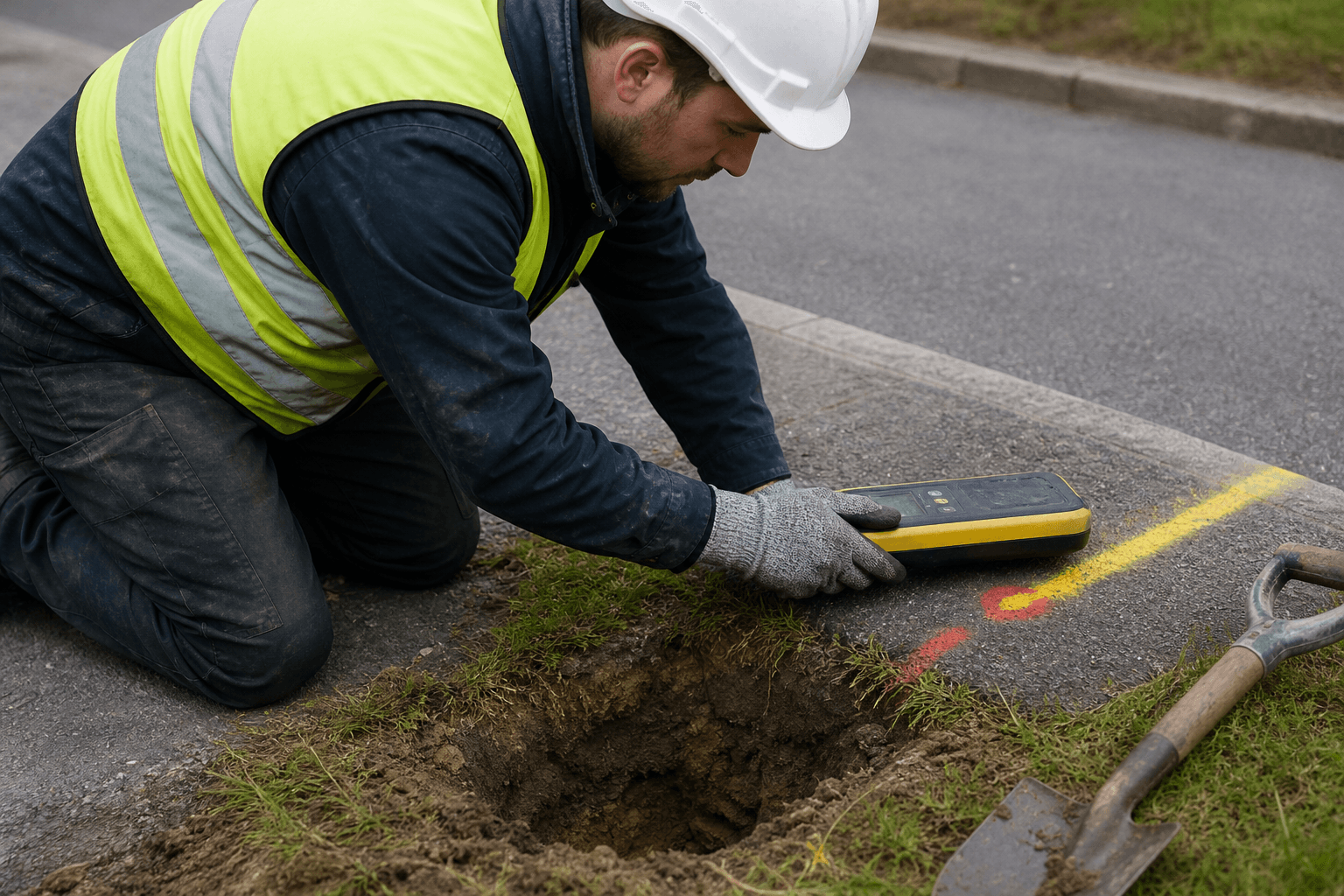
Locating services on site is the step most often skipped, and the HSE guidance is clear that it matters. Always locate services on site before digging. Plans give only an indication of the location, and number of underground services at a particular site, so a competent person should trace cables using suitable locating devices. The people doing this work need to be competent. People who use a locator should have received thorough training in its use and limitations.
Colour can help, but it should never be trusted on its own. Symbols on electricity cable plans may vary between utilities and advice should be sought from the issuing office. The working rule is to assume the worst. Treat all services as LIVE, despite their apparent status until you have confirmed otherwise.
If a service is to be removed, do not assume it is dead.
Practical checklist before you start
- Request service drawings from the owners of the underground services on the site.
- Survey the site and record the position of any services you find.
- Use cable locating equipment, not plans alone, to trace routes on the ground.
- Confirm that anyone using locating equipment is competent to do so.
- Treat every service as live until it has been disconnected and proven safe at the point of work.
- Get written confirmation from the owner before removing any service believed to be redundant.
Step three: excavate safely
Once services are located, excavation must follow safe methods. The HSE guidance says that excavation work should be carried out carefully and follow recognised safe practice, with trial holes dug by hand where needed. Dig trial holes by hand to confirm the position and depth of services. HSG47 advises hand digging near services, using insulated tools and careful techniques.
Mechanical plant is the main source of damage. Mechanical excavation, which is a common source of damage to services. Insulated tools should be used when hand digging near electric cables. near services.
Exposed services need support, and they should never be used to climb on. Concrete should not be used around them. Concrete must not be used to encase services , and the HSE guidance says the same about encasing services during backfilling.
Plant operators need to watch the working area too. Where plant is working near services, the operator and the banksman should keep the excavation under observation, and anyone on site should be alert to the risk of contact.
What to do if a service is damaged
If a service is hit, stop work and make the area safe. If an underground service suffers damage during the excavation or subsequent work, the guidance sets out what must follow, including informing the owner. In an emergency, the advice is to contact the emergency services and the utility owner straight away. Keep people clear of the area and do not attempt to repair a damaged cable or pipe yourself.
Planning for hire is part of the same process. If you need an excavator, a trencher or other plant, confirm with the hire company how it will be used near services, and ask for the operator's experience. For a local supplier, you can start with plant hire options across the UK, or search for digger hire in London if your site is in the capital. Cost depends on the machine size, the length of hire, delivery distance, operator requirements and the time needed for locating services, and you should confirm any figure directly with the company or council before you commit.
Who is responsible
The Construction (Design and Management) Regulations 2015 apply in Great Britain. The client must make suitable arrangements for managing a project, including the allocation of sufficient time and other resources. Those arrangements should be suitable if they ensure that the construction work can be carried out, so far as is reasonably practicable, without risks to the health or safety of any person affected by the project . A designer must also take steps to eliminate or reduce foreseeable risks. These duties apply in Great Britain, so they cover England, Scotland and Wales.
Whether you are a homeowner, a builder or a hire customer, the principle is the same. Find out what is below the ground before you move any earth.
GetBrent makes it easier to find local hire companies for diggers, trailers, tools and other plant, so you can compare options before you book. Check the services on your site first, then search GetBrent to find a suitable supplier near you and confirm the details with them directly.