
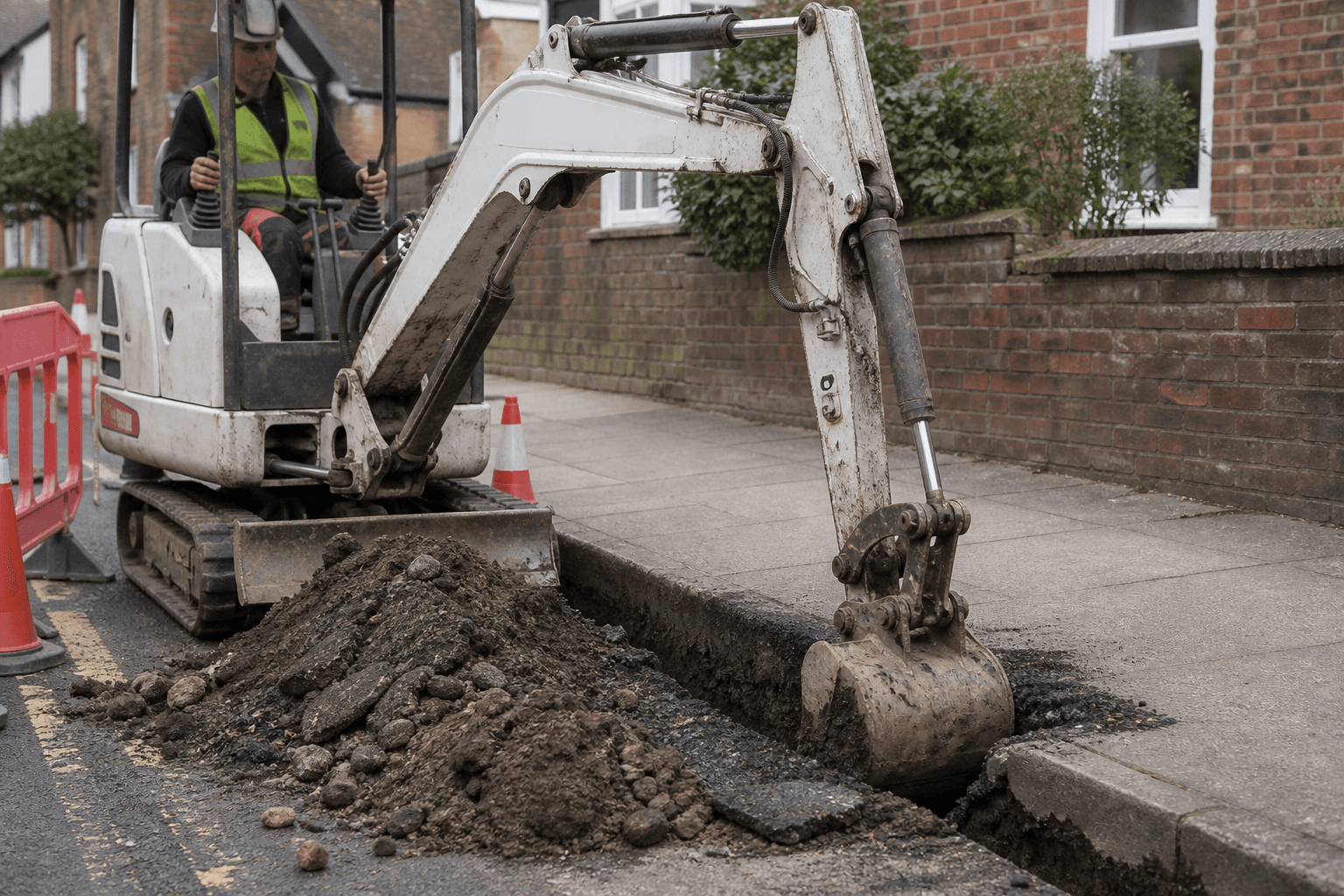
You need a licence from the council before you dig into a public road or pavement with a mini digger, unless you are a utility company. Councils describe this work as a licence, although Merton Council also refers to permission, so use the term the council uses on its application form.
Why the road is different from private land
If you want to carry out work on a public road and you are not a utility company, you need a Section 50 (street works) or Section 171 (temporary excavation) licence from the council. Utility companies, such as those supplying water, gas, electricity and telecoms, can legally do work without a licence. Anyone else will need to apply.
Royal Greenwich Council states that starting street works without a licence is an offence under the Highways Act 1980 and the New Roads and Street Works Act 1991. Royal Greenwich Council says failure to comply may result in prosecution, including full recovery of its costs, and removal of any apparatus or equipment.
Which licence covers your dig
The two licences cover different kinds of work. A Section 171 licence covers excavation on a public road or pavement without installing apparatus. By contrast, a licence is needed to dig up the road to work on things like drains, cables, ducts, sewer pipes, water and gas pipes. Ealing Council describes a Section 171 licence as covering excavation on a public road or pavement without installing apparatus, and Merton Council's small excavation terms cover work such as building walls at the back of the footway.
Location matters too. If the work is on a red route, you will need to contact Transport for London (TfL) for a licence. Merton Council states that you must get permission from the council before excavating a public highway.
Conditions you should expect
Merton Council's terms for small excavations set out practical conditions. The person undertaking the works on the highway must be accredited under the New Roads and Street Works Act 1991, and all excavations must be signed and properly guarded. Care must be taken to avoid damage to statutory undertakers' apparatus, and the named person on the licence is responsible for all costs in connection with repairs to damaged apparatus.
Use this checklist before the machine goes on the street:
- Confirm with the council whether your dig is on the public highway, and whether the road is a red route.
- Apply for the licence before any work starts, and allow time for the council to process it.
- Check who will carry out the excavation and whether they hold the accreditation the council requires.
- Arrange barriers and cones for the duration of the works, and lighting for hours of darkness, as Merton Council specifies.
- Keep records of any services you find, so the licence holder can show what was done.
Check underground services before you dig
A licence does not replace the safety steps for buried pipes and cables. The HSE's guidance, Avoiding danger from underground services (HSG47), explains the three basic elements of a safe system of work during excavation: planning the work, locating and identifying buried services, and safe excavation. The same guidance outlines the potential dangers of working near underground services and gives advice on how to reduce any direct risks to people's health and safety, as well as the indirect risks arising through damage to services.
If you are still choosing the machine, you can browse plant hire listings across GetBrent, or narrow your search to plant hire companies in London if your job is in the capital. Ask any firm you contact whether it has worked with councils on highway licences before, and confirm the licence position with the council directly.
Find local plant hire companies and plant dealers on GetBrent, compare them, and contact them direct to discuss your mini digger job. Confirm any licence, deposit or hire figure with the council or the company, as these vary by authority and depot.