Under the Control of Substances Hazardous to Health Regulations 2002 (COSHH), employers must control exposure to respirable crystalline silica (RCS) below the workplace exposure limit, and HSE guidance expects engineering controls such as water suppression and local exhaust ventilation to be used before respiratory protective equipment (RPE). In Northern Ireland the equivalent regime is the Control of Substances Hazardous to Health Regulations (Northern Ireland) 2003 (COSHH NI).
What the law says about dust
COSHH is the core legal framework. The regulations are made under the Health and Safety at Work etc. Act 1974 and are enforced by HSE and local authority inspectors. airborne material which is capable of penetrating to the gas exchange region of the lung, as defined by BS EN 481 1993 . 10 mg/m^3, as a time-weighted average over an 8-hour period, of inhalable dust, or 4 mg/m^3, as a time-weighted average over an 8-hour period, of respirable dust .
For silica specifically, HSE states that the WEL for RCS is 0.1 mg/m3 expressed as an 8-hour time-weighted average (TWA). HSE also notes that exposure to RCS is also subject to the Control of Substances Hazardous to Health Regulations 2002 (COSHH).
Why silica is treated as serious
HSE explains that respirable crystalline silica (RCS) is found in stone, rocks, sands and clays. It describes how exposure to RCS over a long period can cause fibrosis (hardening or scarring) of the lung tissue with a consequent loss of lung function. HSE also notes that silica may also be linked to lung cancer. Because the dust is invisible at the point it becomes dangerous, HSE's guidance focuses on preventing it becoming airborne in the first place.
The duty to monitor health is also set out in COSHH. HSE states that health surveillance must be provided to workers who are regularly exposed to RCS dust and there is a reasonable likelihood that silicosis may develop. HSE lists construction, foundry work, brick and tile work, ceramics, slate, manufacturing, quarries and stonework among high-risk occupations.
The control hierarchy: extraction first, RPE last
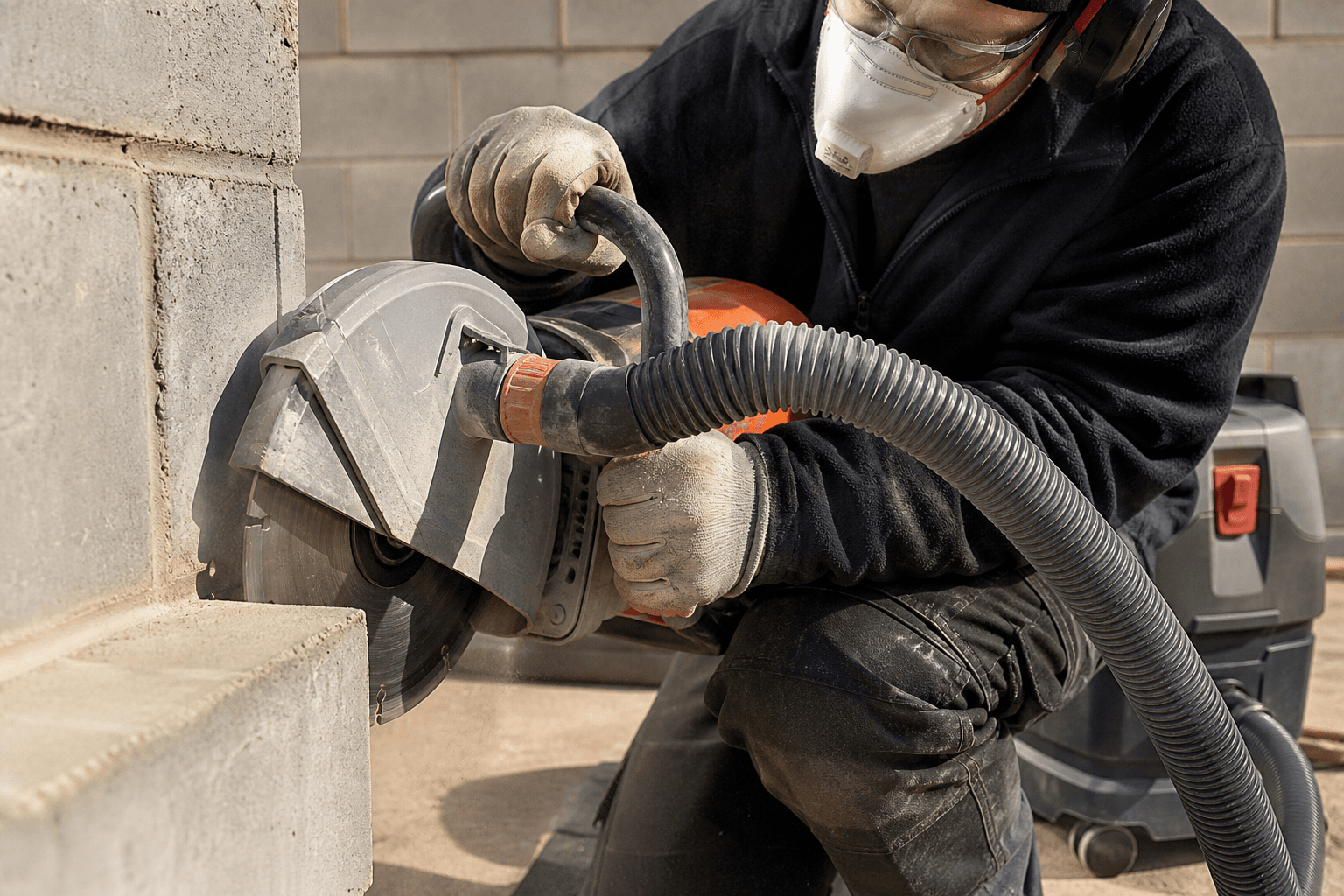
HSE's construction guidance follows a clear order. HSE highlights two primary engineering controls for dusty construction activities - water suppression and on-tool Local Exhaust Ventilation (LEV) . HSE's wider stonemasonry guidance, HSG201, describes how risk assessment, process design, water suppression, Local Exhaust Ventilation (LEV), Respiratory Protective Equipment (RPE), health surveillance, workplace exposure monitoring and housekeeping work together as one strategy.
On RPE, HSE is clear that masks come after engineering controls. Guidance from HSE's construction dust material notes that respiratory protective equipment (RPE) is required, especially where materials contained silica. That point should be checked against HSE's own publications before you rely on it.
Practical checklist for tool hire customers
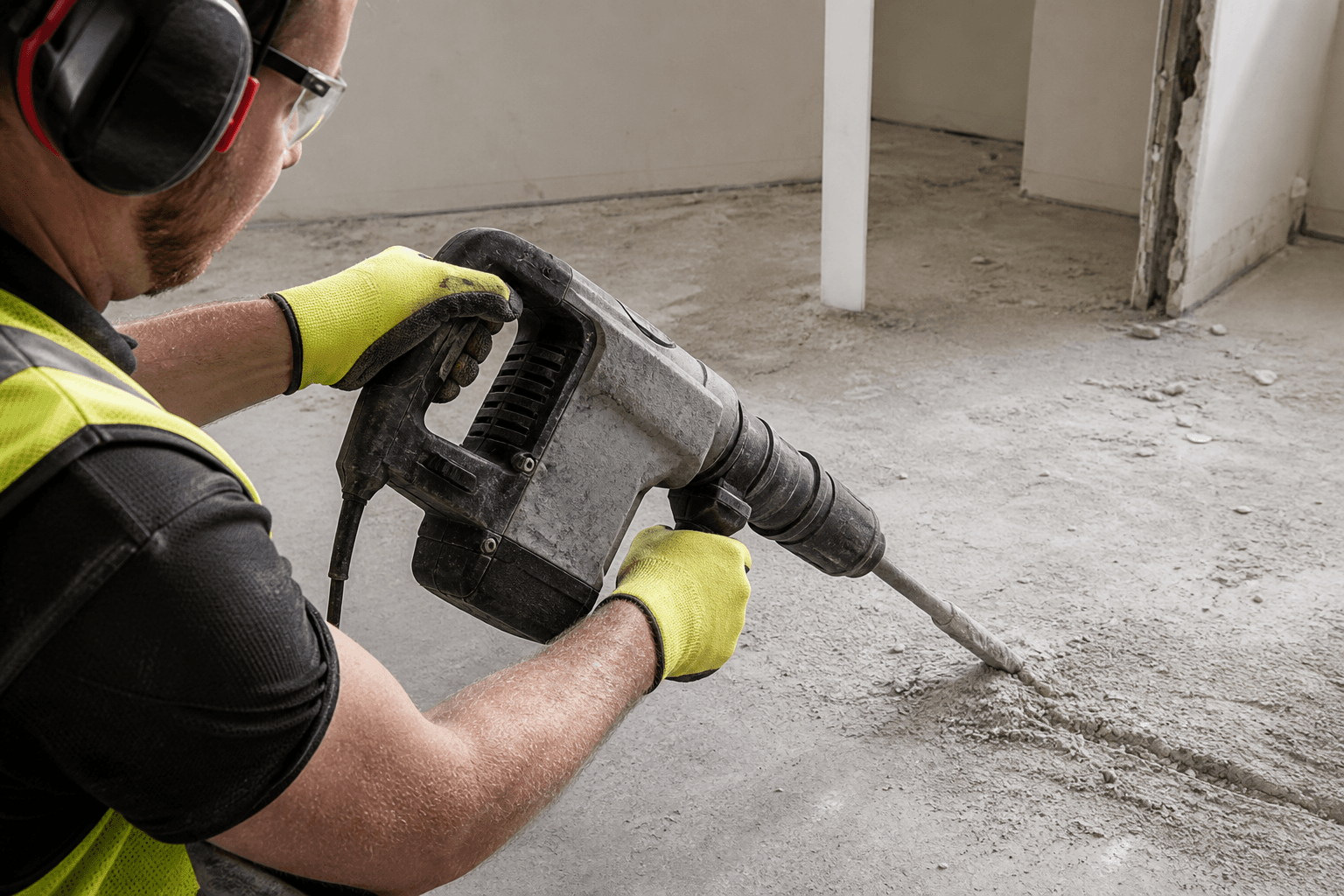
If you are hiring a cut-off saw, grinder, breaker or drill for work that disturbs concrete, brick, stone or screed, the following steps reflect what the HSE sources describe:
- Assess the task first. COSHH requires an assessment of the risk to health from work involving hazardous substances, so identify whether the material contains silica before you start.
- Use wet methods where practical. Water must be applied continuously at the point of dust generation - the cutting blade, the drill bit, the grinding disc.
- Match the extractor to the job.
- Keep extraction running. HSE's guidance says a machine should be used equipped with exhaust ventilation , and that the observer should make sure that such ventilation is used.
- Clean without sweeping. Avoid dry sweeping, which can re-suspend settled dust into the air, and use vacuums instead.
- Provide RPE where risk remains. Check it fits the wearer and is suitable for the hazard.
Differences across the UK nations
The COSHH Regulations 2002 apply across Great Britain, while Northern Ireland uses COSHH NI. HSE Northern Ireland states that duty holders must assess the risks from silica dust and implement controls measures in line with COSHH NI and HSE's Control of substances hazardous to health (COSHH). The workplace exposure limit is the same figure in both regimes. Enforcement, however, sits with different bodies, so check the regulator for the site you are working on.
Hiring a tool does not transfer the duty. The person who controls the work remains responsible for the risk assessment, the extraction and the RPE. Before you collect a machine, confirm with the hire company what extraction or water feed it supports, and check the detail with the company or your local council.
If you are looking for a supplier, you can compare tool hire options across the GetBrent marketplace, or search for tool hire in London if your site is in the capital. Ask the company whether the machine is fitted with the right extraction class for silica work before you book.
GetBrent lists local firms that hire tools, plant and equipment, so you can find a supplier near your site and ask the right questions before you book. Start by searching for a tool hire company in your area, then confirm the extraction and dust control details directly with them.