The class you need depends on the access you have, the depth and reach the job requires, and how you will move the machine between sites. This guide explains the typical size bands, what drives the choice, and the legal and safety points to confirm before you hire, drawing on HSE and UK road transport guidance.
Typical mini digger size bands
Exact specifications, reach and dig depth vary by make and model, so compare the manufacturer's data sheet for the specific machine rather than relying on a weight class alone.
Transport and towing: what the rules say
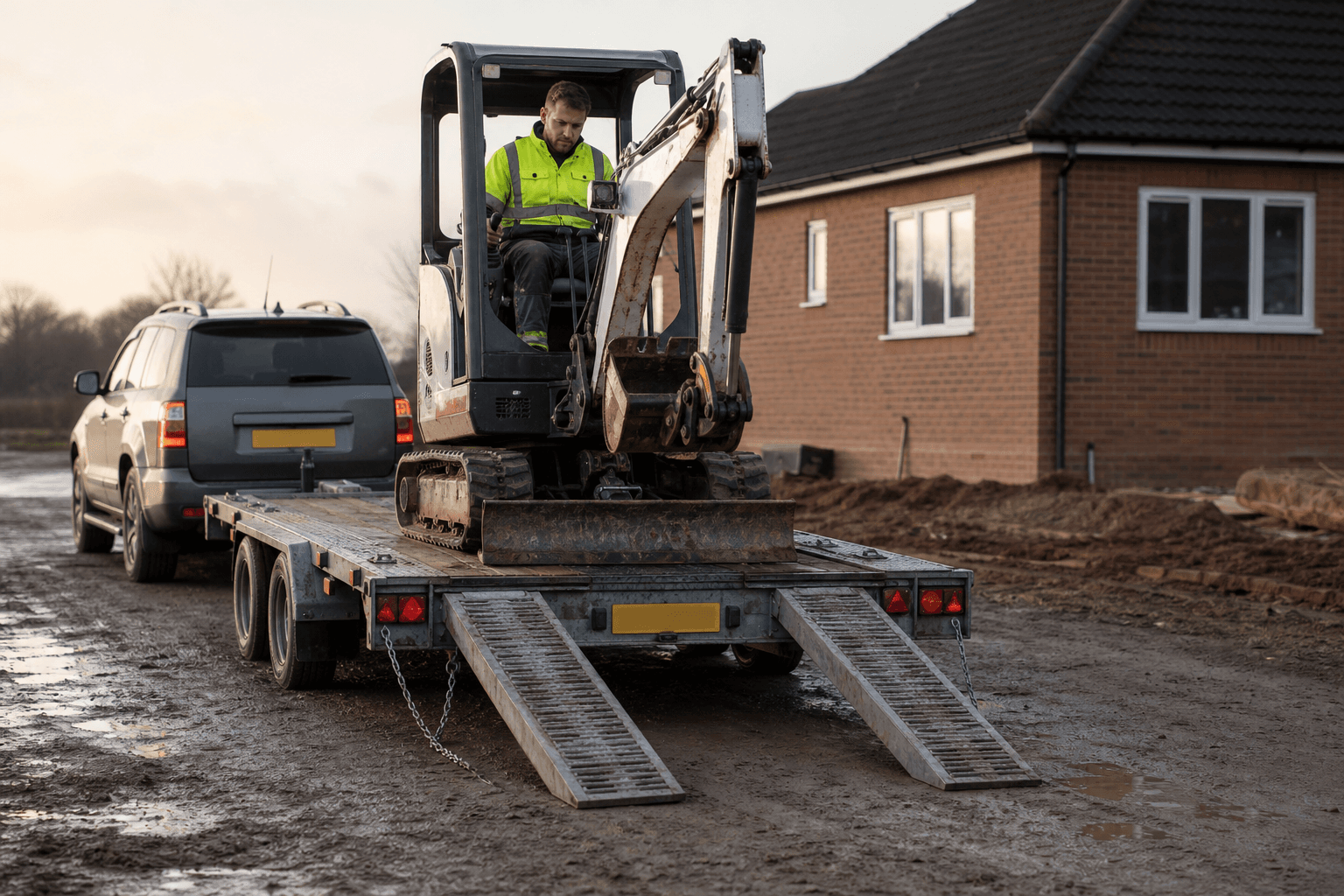
Moving a digger is where many hirers run into trouble. The Highway Code NI sets out that drivers towing a trailer must give other vehicles plenty of room, because the extra length affects overtaking and manoeuvring and the extra weight affects braking and acceleration. Under the Northern Ireland rules, if you passed your driving test on or after 1 January 1997 and have an ordinary category B (Car) licence, you are limited to vehicles up to 3.5 tonnes (3,500kg) MAM towing a trailer up to 750kg MAM, or a vehicle and trailer combination up to 3.5 tonnes (3,500kg) MAM. For anything heavier you need to pass a category B+E driving test.
Trailers also carry their own brake requirement. Under Northern Ireland guidance, any trailer weighing over 750kgs must have a working brake system. A plant trailer carrying a mini digger will almost always exceed this figure once the machine is loaded.
Securing the load matters as much as the weight limit. Guidance on transporting plant notes that For light plant, guidance states that
A further point applies to the machine itself. The Construction Plant-hire Association notes that Towing is only possible under a Vehicle Special Order, and Your hire company should confirm whether any tow is intended.
Safety and operator training
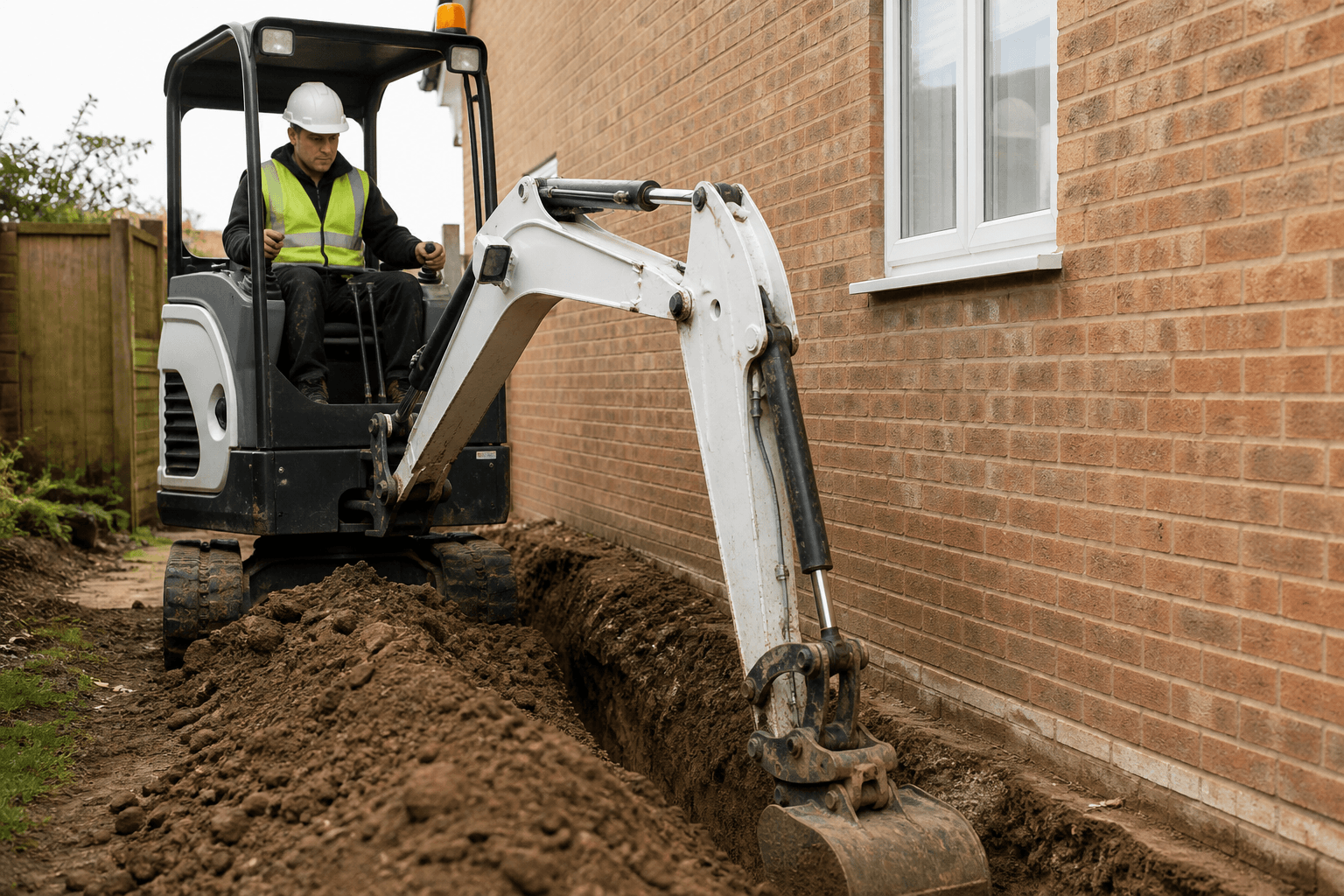
The HSE's guidance on excavators sets the baseline for site safety. The law says you must organise your site so as to segregate pedestrians and excavators. Most fatal and serious injuries involving excavators occur when the excavator is moving and strikes a pedestrian, particularly while reversing , so exclusion zones and clear sightlines are essential. On the training side, the HSE states that those excavators used must be carefully selected, maintained and operated by trained drivers.
If the digger will be used to lift loads, the requirements tighten. The HSE says that duty holders must ensure that a suitable and sufficient risk assessment is in place for work activities where excavators are used as lifting appliances. The HSE also states that employers or duty holders must ensure that machine operators, slingers and others are competent for the task.
The HSE safety notice on isolation adds a practical rule. If there are people in the operational arc of an excavator or similar mobile plant, the safety control lever should be applied, or other methods used, to isolate the machine, while it is at rest (ticking over).
Practical checklist before you hire
- Confirm the operating weight and the dimensions of the machine against your access route and the space on site.
- Check the trailer and towing vehicle combination against the weight limits for your driving licence before you collect the machine.
- Ask how the machine will be secured, and whether the trailer has the physical barriers and lashing points required for tracked or heavy plant.
- Confirm who will operate the machine and what training they hold, and whether a risk assessment is needed for any lifting use.
- Check that the machine has a working safety control lever or isolation device, and that visibility aids are fitted.
- Confirm the hire cost, delivery charge and any insurance terms directly with the company, as these vary by provider and location.
What drives the cost of hire and transport
The price of hiring a mini digger depends on factors such as machine size, hire length, delivery distance, the type of trailer needed for transport and the level of operator support included. Prices vary between depots and regions, so there is no single standard figure to quote. Confirm the figure with the hire company before you commit, and ask for the delivery and collection charges to be itemised so you can compare providers on a like-for-like basis.
If you are looking for a machine nearby, you can compare mini digger hire in London alongside options in other areas, or browse the full range of plant hire listings on GetBrent.
GetBrent lists local plant hire companies across the UK, so you can compare machine sizes, transport options and availability in one place. Use the checklist above when you speak to each provider, and confirm all costs in writing before you book your machine.