
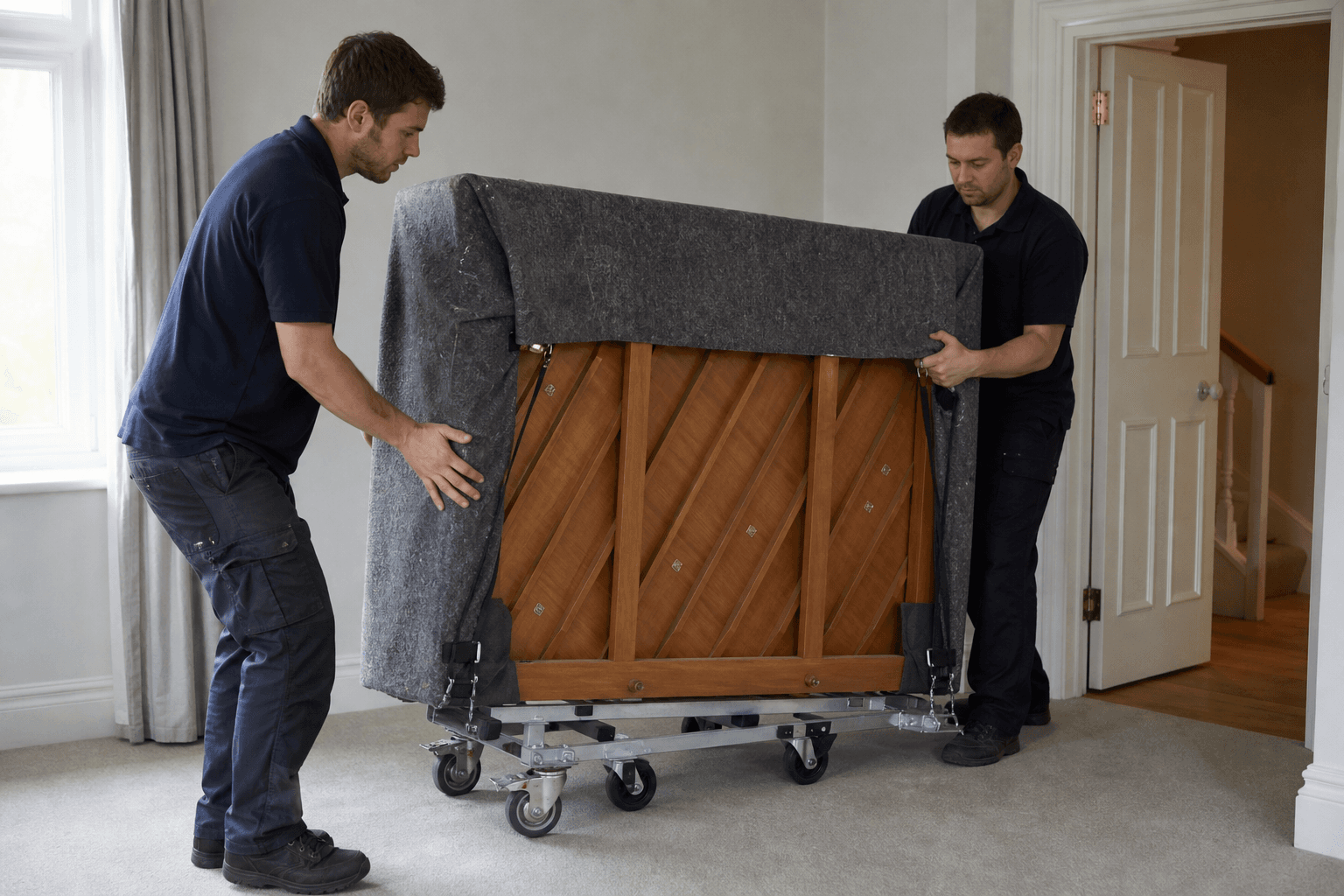
Moving a piano is not simply a matter of adding extra pairs of hands to a standard removals team. The instrument's weight, centre of gravity, fragile internal mechanisms and sensitivity to impact place it in a category that requires dedicated planning, specialist equipment and staff trained specifically for the task. Understanding why that distinction matters helps owners make better decisions before booking a removal and avoid problems on the day.
Why a Piano Is Not Like Other Furniture
An upright piano is among the heaviest objects found in a typical home. , That weight alone sets a piano apart, but weight is only part of the problem.
The load is also awkwardly distributed. An upright piano is heavily weighted towards the back, which increases the risk of tipping during any movement. A grand piano presents a different challenge: its horizontal profile, three legs and protruding lyre assembly make it impossible to manoeuvre through standard doorways without first removing components and repositioning the body on specialist equipment. Incorrect support or component removal can damage the piano or cause sudden, uncontrolled movement - a risk that grows sharply when the crew is unfamiliar with the specific instrument.
Beyond the structural challenge, a piano contains thousands of delicate moving parts - strings, hammers, dampers and felts - that are sensitive to shock and vibration. A hard knock during a move can affect tuning stability and, in severe cases, damage internal components that are expensive to repair.
What the Law Requires of the Removal Firm
Any firm whose workers lift, carry, push or move loads as part of their job must comply with the Manual Handling Operations Regulations 1992, enforced in Great Britain by the Health and Safety Executive (HSE). The Manual Handling Operations Regulations require employers to avoid, assess and reduce the risk of injury from manual handling.
The Regulations set a fixed order of priority. Employers must first avoid hazardous manual handling operations so far as is reasonably practicable; second, assess any hazardous manual handling operations that cannot be avoided; and third, reduce the risk of injury so far as is reasonably practicable. Applied to a piano move, this means a responsible firm must begin by asking whether the handling can be eliminated or mechanised before considering how to do it by hand.
The Regulations require hazardous manual handling to be avoided where reasonably practicable and otherwise assessed and the risk reduced. Planning should consider load weight and distribution, grip, posture, carrying distance, stairs, floor condition, individual capability, team size and mechanical assistance. Adding people without a coordinated method does not automatically make a move safe.
A general household removals team is not typically trained or equipped to satisfy these requirements for a piano. That is one of the core reasons why the job is treated separately by professional firms.
What Specialist Equipment and Preparation Look Like
Competent piano movers use dedicated equipment that general removal firms do not carry as standard. Specialist piano removers use dedicated equipment including skid boards, stair-climbing trolleys and heavy-duty strapping. For grand pianos the legs must be removed and the body secured on a specialist board before any movement begins.
Grand pianos require a specialist planned procedure. Depending on the instrument and method, components such as legs, pedal lyre and music desk may need to be removed and individually protected before the main body is positioned on suitable specialist equipment.
A pre-move survey is an important step that reputable firms carry out before accepting the job. Due to the specialist nature of piano removals, a site visit is essential. An experienced surveyor will attend the property to assess access points, flooring, stairways and any challenges specific to the type of piano being moved. This allows the firm to plan the safest, most efficient approach, whether it involves internal manoeuvring, removing windows or arranging lifting equipment.
Once the piano is on the vehicle, the work is not finished. Once inside the removal vehicle, the piano must be positioned and secured correctly to prevent movement during transit.
Insurance and Trade Accreditation
Standard household removal insurance is unlikely to cover a piano at full replacement value. A general household removal policy might cap cover per item at a level that would not come close to replacing a quality piano. Owners should confirm in writing what a mover's policy covers and up to what value before agreeing to any booking.
The British Association of Removers (BAR) is the leading trade body for the removals industry in the UK. The British Association of Removers represents professional removal and storage companies throughout the UK. Becoming and remaining a member involves meeting required standards relating to areas such as staff training, customer service, operational procedures, vehicles, equipment and business practices.
The British Association of Removers (BAR) sets professional standards around handling, equipment and insurance that its members must meet. When moving something as specialist as a piano, checking whether a firm is BAR accredited and specifically experienced in piano moves is a sensible first step rather than an optional extra.
Firms that belong to BAR also have access to an Alternative Dispute Resolution Scheme, independently operated by the Furniture and Home Improvement Ombudsman, which gives customers a route to resolve complaints without going to court.
A Checklist: What to Confirm Before Booking a Piano Mover
Use the following checklist when speaking to any firm about moving a piano. If a firm cannot answer these questions clearly, look elsewhere.
- Do they move pianos as a specific service, not as an add-on to a general removals booking?
- Are they members of the British Association of Removers (BAR) or another recognised trade body?
- Will a surveyor visit the property before the move to assess access, stairs and floor loading?
- What specialist equipment will they bring - skid board, piano dolly, stair-climbing trolley, strapping?
- How many trained crew members will attend, and what is their experience with this type of piano?
- What does their insurance cover, and can they confirm the per-item limit in writing before the job starts?
- Do they offer a tuning recommendation or referral after the move, given that transport almost always disturbs tuning?
- What is the agreed route through the property, and has the firm accounted for every doorway, turn and staircase?
Booking as Part of a House Move
Many owners assume that their general removals firm will handle the piano along with everything else. In most cases, a reputable general firm will flag the piano as a specialist item early in the survey and either bring in a specialist subcontractor or decline the item entirely. Piano removals are a specialist area of work, requiring the equipment and practical experience to undertake them either as part of a complete house move or as an individual transportation service.
If the general removals firm does not raise the subject of the piano unprompted, the owner should. It is worth confirming in writing which firm is responsible for the piano, what equipment they will use and what the insurance position is, before contracts are signed for the wider move.
For owners in the capital, house removals in London often involve additional access challenges - restricted parking, narrow Victorian hallways and upper-floor flats - that make specialist piano handling even more important to plan in advance. Those moving locally can also find house removals in Brentford or house removals in Isleworth through GetBrent's directory, where firms listing specialist services can be filtered and compared.
GetBrent brings together removals and logistics firms from across the UK, including specialists who handle pianos as a distinct service. Use the marketplace to find, compare and contact accredited firms in your area, confirm their experience with your type of instrument, and get the insurance position confirmed before any booking is made.