A telehandler suits jobs requiring height and reach with variable loads; a forklift works best for moving palletised goods repeatedly at ground level. The choice depends on your specific task, available site space, and the way you need to load and position materials.
What is a telehandler?
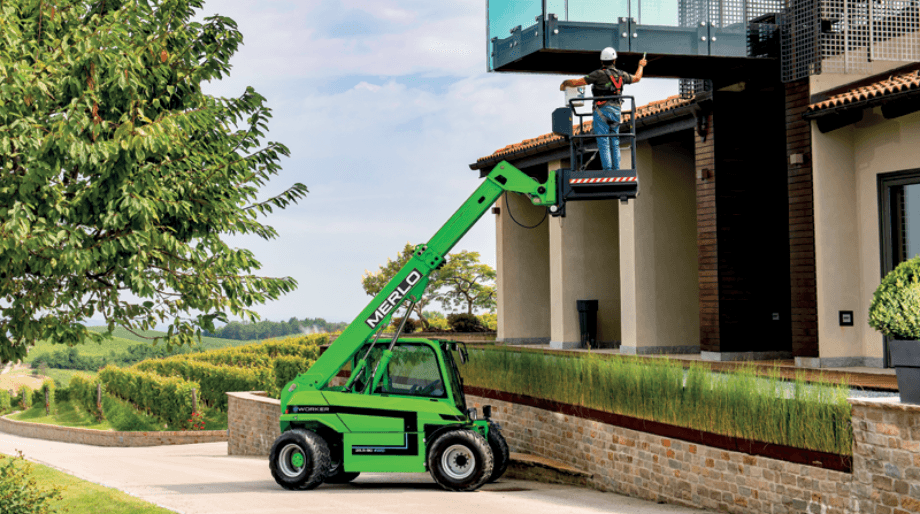
A telehandler is a mobile boom lift with a telescoping arm that extends horizontally and vertically. It can reach high and far while carrying loads, making it ideal for stacking materials at height, loading lorries, or placing items on scaffolding and upper floors. The arm can tilt and rotate, giving the operator flexibility to position loads at angles and in tight spaces.
Telehandlers come in different sizes, typically ranging from 2.5 to 4.5 tonnes capacity, and their reach varies from 6 to 17 metres depending on the model. This versatility makes them popular on construction sites, farms, warehouses, and during renovation work.
What is a forklift?
A forklift is a powered industrial truck designed to lift and move palletised goods. Two forks extend forward from the mast, slide under a pallet or load, and lift it vertically. Forklifts work best for repetitive handling of uniform loads—moving stock in warehouses, shifting pallets of bricks or bags, or loading and unloading lorries where goods are already on pallets.
Forklifts have a fixed lifting height and limited reach. They work efficiently in warehouses and on level ground but cannot reach high angles or place loads at height in the way a telehandler can.
Key differences to guide your choice
Reach and height
If you need to place materials high up—on scaffolding, a second-floor window, or into an upper-storey framework—a telehandler is the tool. Forklifts lift vertically but do not extend horizontally; their maximum height is also lower, typically 4.5 to 6 metres.
Load shape and type
Forklifts assume palletised loads with a standard footprint. If your materials are irregularly shaped, loose, or come in bags and boxes not on pallets, a telehandler is more adaptable. The bucket or grab attachment on a telehandler can handle loose loads, rubble, or odd-shaped items.
Space and manoeuvrability
Forklifts have a tighter turning radius and work well indoors and in confined spaces. Telehandlers need more room to operate safely because the boom extends outward; they work better in open areas or outdoors. On a small warehouse floor or between narrow aisles, a forklift is more practical.
Operator training and licensing
Both machines require trained, competent operators. The HSE expects employers to ensure operators have been properly trained and assessed. Forklift operators and telehandler operators are often trained separately because the machines handle very differently. Confirm that any hire company provides evidence of operator competency before the machine is delivered.
Practical checklist: deciding between the two
- Do you need to place loads at height or at a distance? If yes, choose a telehandler.
- Are your loads palletised and uniform? If yes, a forklift may be sufficient.
- Is your site confined, narrow or indoors? If yes, a forklift is often better.
- Do you have open ground or outdoor space? If yes, a telehandler works well.
- Will you move the same load type repeatedly or different materials? Repetitive pallet work suits a forklift; varied jobs suit a telehandler.
- What is your budget and hire duration? Confirm both hire terms and operator costs with the company.
Safety and regulations
Both machines are subject to HSE guidance on safe use of work equipment. The site supervisor or project manager must ensure the machine is appropriate for the task, that the ground is suitable for its weight and tyre type, and that the operator holds valid training certification. The operator must carry out daily checks and report faults immediately.
If you are working at height or near edges, additional measures such as banksmen, barriers, or exclusion zones may be required under the Work at Height Regulations. The hire company should advise on these points when you book.
Telehandlers and forklifts used on public roads may require insurance and, in some cases, a valid operator's licence. Confirm legal requirements with the hire company and your transport provider.
Finding the right machine for your project is straightforward once you understand the job. Browse local plant hire options through GetBrent to compare available telehandlers and forklifts in your area, check what training and insurance each company provides, and book the equipment that fits your site and schedule.