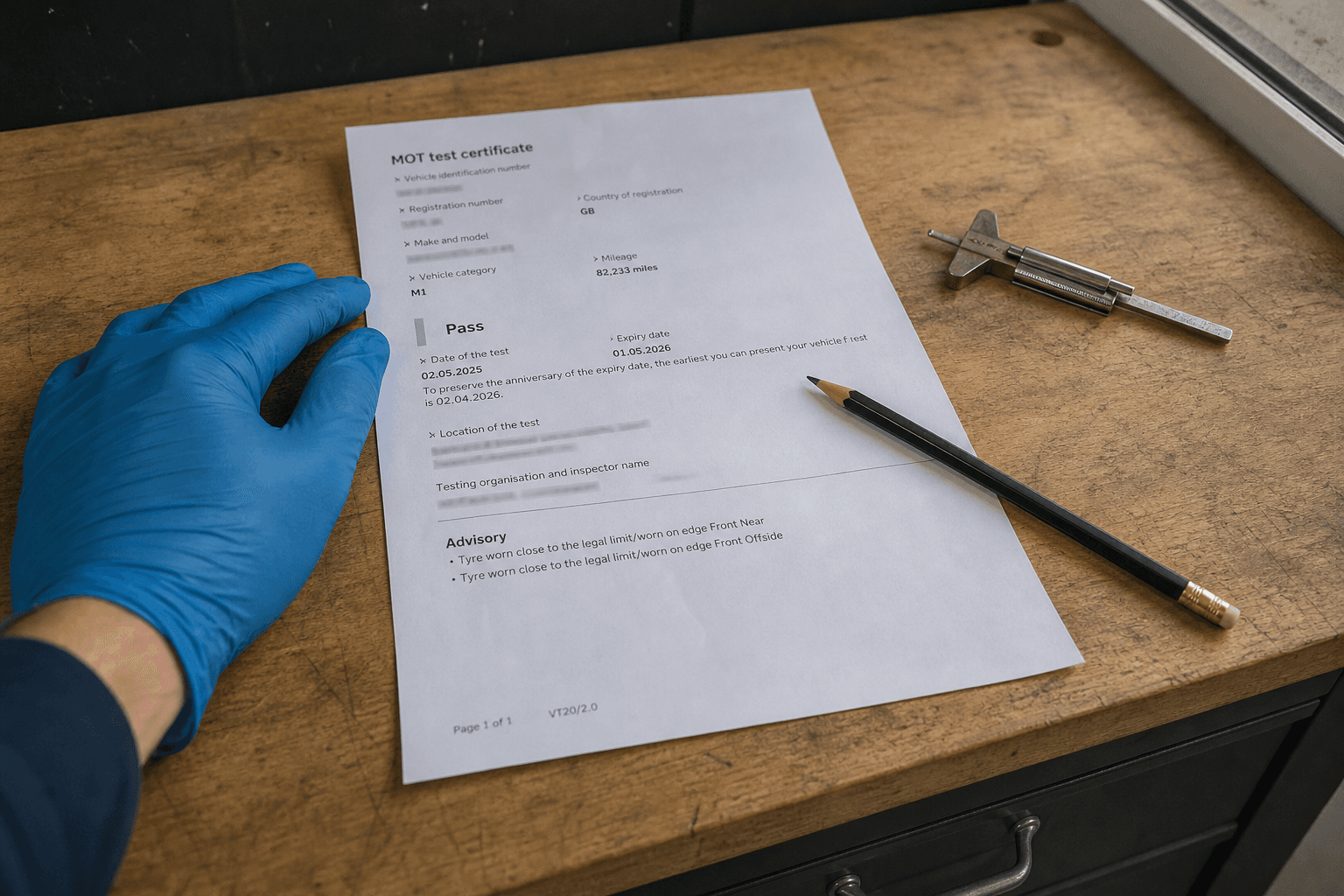
An MOT advisory is a note on a passed MOT certificate about an item that could become more serious in the future, and the owner is told to monitor it and repair it if necessary. It does not mean the vehicle has failed, and it is recorded so that anyone can see it later.
Whenever you buy a used car, hire a van or take on a trailer with an MOT history, the advisories on record tell you how the vehicle has been looked after. Knowing what they mean helps you decide what to ask the seller or hire firm before you commit.
How an advisory differs from a defect
The MOT result categories are advisory, minor, major and dangerous. The result sits in a clear order:
- Advisory: the MOT is a pass, and the item should be monitored and repaired if necessary.
- Minor: the MOT is a pass, and repairs should be carried out as soon as possible.
- Major: the MOT is a fail, and repairs are required.
- Dangerous: the MOT is a fail, and the vehicle should not be driven until repaired.
The RAC describes the advisory result as an MOT pass but a result to monitor and repair if necessary. Advisories are therefore a warning about the future rather than a current fault. Tyre tread is a common example: a tyre that is still legal but close to the limit can be recorded as an advisory, while a tyre below the minimum is a failure.
Do you have to fix an advisory?
An advisory does not automatically require a repair before the car can be driven. The RAC notes that MOT advisories highlight issues that do not currently cause the vehicle to fail its MOT, but which may deteriorate and require attention in the future . Repairing it is a matter of judgement, but the owner remains responsible for the vehicle at all times. The RAC's guidance on advisories makes the same point, so it is worth treating the item as a priority rather than ignoring it.
The position is different once an item deteriorates. Advisory items are not a safe harbour: if a recorded item later becomes a defect, the car can fail its next test, and the law on roadworthiness applies regardless of the certificate. Acting early is usually cheaper than waiting for the item to fail completely.
How to check a vehicle's advisories
Before you buy a used car, or before you agree to hire or take on a vehicle, you can look at its record yourself. The official service is the GOV.UK Check MOT history page, which you can use with only the registration number. The GOV.UK service shows the past results of a vehicle's MOT tests, including whether it passed or failed and the mileage recorded when tested. Records for Northern Ireland start from 2017, so the earlier history is not online there.
Look for patterns rather than single entries. The same advisory appearing at consecutive tests suggests the item has not been repaired, and that is a question to put to the seller or the hire firm. A vehicle's MOT record shows what was recorded, but it does not show the full mechanical condition, so it should be read alongside the service history.
Practical checklist
- Enter the registration on the GOV.UK Check MOT history service and note every advisory listed.
- Check whether the same advisory appears at more than one test.
- Ask the seller, owner or hire firm what work has been done on each advisory item.
- Ask for the service history and check it matches the advisories.
- For tyres, measure tread yourself. Cars, light vans and light trailers must have a tread depth of at least 1.6 mm across the central three-quarters of the breadth of the tread and around the entire circumference.
If you need a vehicle repaired or serviced after reviewing its advisories, you can compare vehicle repair and MOT garages in London and contact them directly. For commercial vehicles and trailers, compare options through the vehicle and plant repair category.
GetBrent helps you find local hire companies, vans, trailers and plant, as well as garages and workshops that can inspect and repair them. Use the marketplace to compare firms near you and contact them directly before you commit.