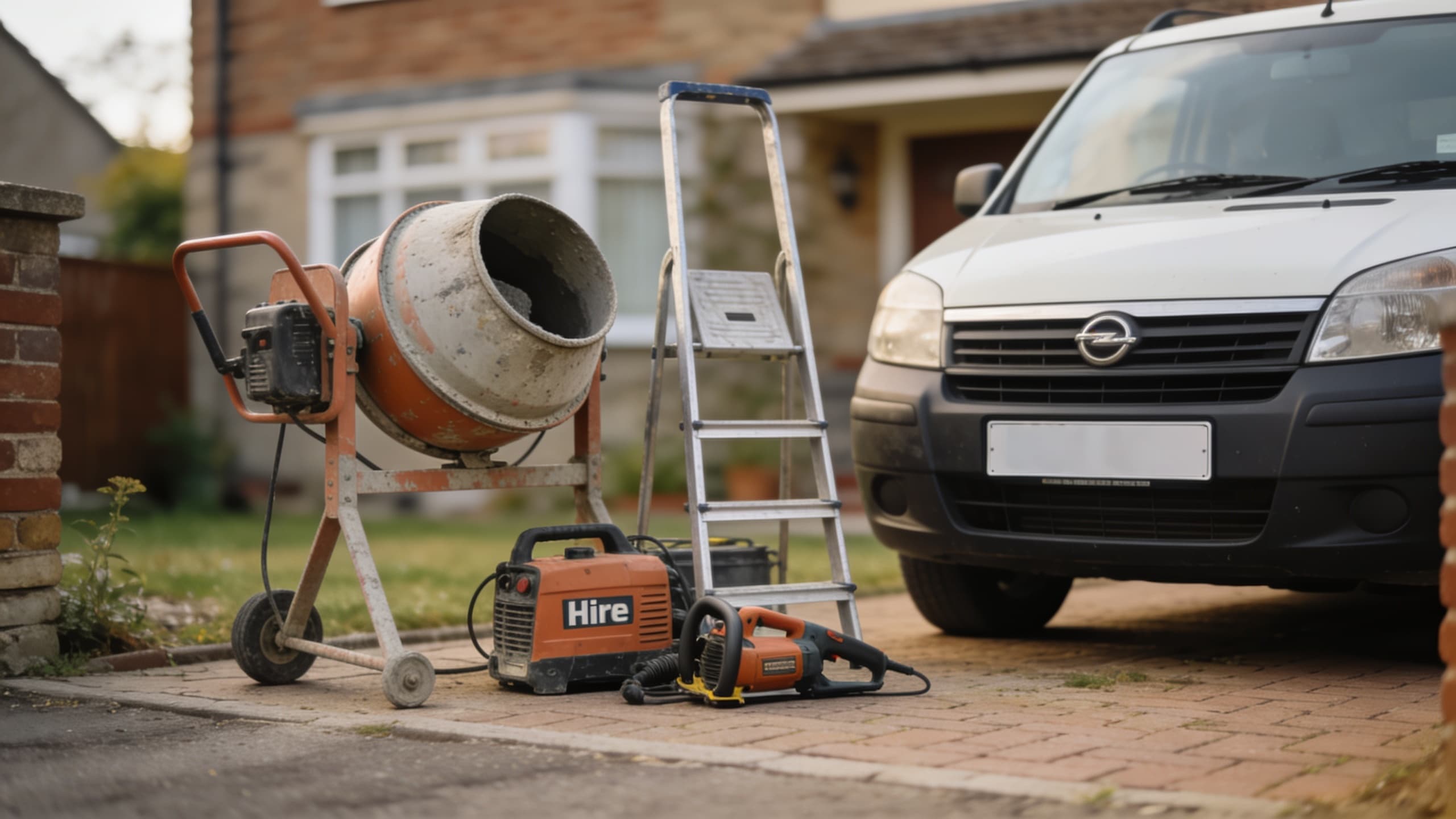

For most one-off or short-term needs, hiring is the practical default. It sidesteps upfront capital spending, removes the burden of long-term maintenance and means a large, infrequently used asset does not occupy yard or garage space between jobs. The calculation shifts - sometimes decisively - once a piece of equipment is needed regularly, when specialist kit is hard to find in the hire market, or when ownership delivers an operational advantage that justifies the cost. Understanding which situation applies, and what the law says about each route, is what this guide is for.
The General Rule: Hire for Infrequent Use, Buy for Regular Use
The clearest way to think about this decision is frequency of use. A tool or machine needed for a single project, a seasonal task or an occasional emergency is almost always cheaper and simpler to hire. The hire company has the machine, it is ready to use, and the hirer returns it when the job is done. Buying the same item locks up capital in an asset that then needs insuring, storing and maintaining.
The rule flips when the same piece of equipment is needed week after week. At that point the cumulative hire cost typically exceeds the purchase price within a defined period, storage and maintenance become worthwhile problems to solve, and ownership gives the operator more flexibility - no availability risk, no collection deadlines, no dependency on a depot's opening hours. Browse tool hire categories on GetBrent to see what is available locally before deciding which route suits a particular job.
A useful prompt when weighing the options:
- How many times per year will this be used? Fewer than a handful of times almost always favours hire.
- Does it need specialist knowledge to operate? Some plant comes with a trained operator as part of the hire arrangement, which shifts the balance further toward hire.
- Where will it be stored? Bulky or heavy equipment needs secure, weatherproof space. If that space does not exist or has a cost, factor it in.
- What are the maintenance obligations? Some categories of work equipment carry statutory inspection requirements under the Health and Safety Executive's guidance (see below), and these obligations fall on the owner when equipment is bought outright.
- Is the technology likely to improve? Rapidly developing equipment categories - battery-powered tools are a current example - can mean a purchased item is outdated quickly, whereas hire gives access to current stock.
Safety Duties: Who Is Responsible for What
The legal picture is an important part of the hire-or-buy decision, particularly for businesses and the self-employed. The Provision and Use of Work Equipment Regulations 1998 (PUWER), enforced by the Health and Safety Executive (HSE), place duties on people and companies who own, operate or have control over work equipment, and also on businesses whose employees use work equipment, whether owned by them or not.
PUWER requires that equipment provided for use at work is suitable for the intended use, safe for use, maintained in a safe condition and inspected to ensure it does not subsequently deteriorate, and used only by people who have received adequate information, instruction and training.
When equipment is hired rather than bought, these responsibilities are shared rather than transferred entirely. Those hiring out equipment for use at work are considered suppliers under section 6 of the Health and Safety at Work Act and so have broad responsibilities for the safety of the products they hire out, including - so far as reasonably practicable - pre-hire testing and inspection and the provision of information. However, those hiring out work equipment cannot normally be responsible for the day-to-day and other pre-use safety checks, which should be undertaken by the user.
When buying new machinery for use at work, the obligations rest with the purchaser. Employers must ensure that all work equipment they provide conforms with the essential requirements of product supply law relating to its design and construction. Reasonable checks for safety should be made when selecting and acquiring new work equipment, including checks for obvious danger such as missing or damaged guards, appropriate conformity marking and labelling, and that the instructions and Declaration of Conformity are in English.
Trailers: Check Your Licence Before You Hire or Buy
Trailers are one of the most commonly hired items on the GetBrent platform, and the legal position on towing changed in December 2021. Anyone considering hiring or buying a trailer should confirm their licence entitlement before doing so, because towing the wrong weight without the correct entitlement is a road traffic offence.
You can tow trailers up to a certain weight with a car driving licence. The weight you are allowed to tow depends on when you got your licence. You need to know the weight of both the vehicle and trailer - also known as the maximum authorised mass (MAM). The MAM is listed in the owner's manual and is normally shown on a plate or sticker fitted to the vehicle or trailer.
If you got your licence from 1 January 1997, you can tow a trailer that weighs up to 3,500kg MAM. This is confirmed by GOV.UK's towing guidance. To tow combinations heavier than what your current licence allows, you need to apply for a provisional licence for a medium-sized lorry and trailer (category C1+E).
Always check the MAM plate on the trailer itself, not just the hire company's description, and verify that your towing vehicle's own rated towing limit is not exceeded. If you are looking for trailer hire near you, tool and equipment hire in London or the surrounding area is a good starting point for finding local suppliers.
Skips: When Hire Comes with a Permit Obligation
Hiring a skip is one of the clearest examples of hire that carries additional legal steps, and getting this wrong can result in fines or the skip being removed at the hirer's expense.
The key rule is straightforward. If the skip will be placed on private land such as a driveway or private building site, a permit is usually not required. However, if the skip will be placed on a public road or pavement, the hirer must obtain a skip permit from the local council before delivery. This is a legal requirement throughout the UK.
The permit is applied for by the skip hire company, not the customer, but the obligation to ensure it is in place rests with the hirer. Confirm with the hire company before booking that they will handle the permit application. Regulations for skips on the highway can be found within Part IX of the Highways Act 1980. Permit fees are set by each local council independently, so confirm the figure directly with the council or the hire company - do not rely on figures published elsewhere, as they vary considerably between authorities.
A quick checklist for skip hire compliance:
- Private land placement - confirm the skip will sit entirely within your property boundary. No permit is needed in this case.
- Public road or pavement placement - the hire company must apply for a council permit before the skip is delivered.
- Licensed waste carrier - check the company is registered as a licensed waste carrier. The Environment Agency maintains the public register of licensed operators.
- Permit duration - confirm how long the permit covers and what happens if your project overruns that period.
- Prohibited materials - ask the hire company for a list of items that cannot go in the skip, as accepting prohibited waste can create liability for the hirer as well as the operator.
When the Default Rule Breaks: Exceptions Worth Knowing
The hire-for-infrequent, buy-for-frequent rule has well-established exceptions that can flip the decision even at low frequencies of use.
Availability and timing. Hire depots can run out of popular equipment at peak times - spring and summer for garden and construction kit, for example. If a project schedule cannot flex around depot availability, ownership removes that risk. Hirers in areas with fewer depots may find tool hire in Enfield or tool hire in Harrow useful for comparing what is available locally before committing to a purchase.
Customisation. Some tasks need a machine configured in a specific way - extended hoses, non-standard attachments, specialist blades. Hire stock is set up for general use. A buyer can fit and keep a specific configuration permanently.
Continuity of inspection records. For lifting equipment subject to the Lifting Operations and Lifting Equipment Regulations 1998 (LOLER), those hiring out work equipment have responsibilities under PUWER and, if lifting equipment is involved, LOLER, in so far as they exercise control over that equipment - for example, ensuring the thorough examination of lifting equipment and other routine inspections have taken place at the required intervals. It may be appropriate for the user to organise the periodic thorough examinations, which should be by written agreement, particularly for long-term hire. Businesses that use lifting equipment continuously often find it simpler to own the asset and manage the examination schedule themselves.
Second-hand purchase as a middle path. Section 6 of the Health and Safety at Work Act requires all products supplied for use at work - whether new or second-hand - to be safe, so far as reasonably practicable. This requirement includes the provision of instructions for the safe use of the equipment. Buyers should satisfy themselves that any second-hand article purchased for use at work is safe for use, and they should be supplied with adequate information about the intended use of the equipment. A well-maintained second-hand machine bought at a lower price can change the hire-or-buy calculation significantly for mid-frequency use.
GetBrent connects people across the UK with local hire companies, clearance firms, tradespeople and equipment suppliers. Whether you need a one-day tool hire, a long-term van arrangement or help finding a licensed skip operator in your area, searching GetBrent puts verified local options in one place so you can compare, contact and get the job done.