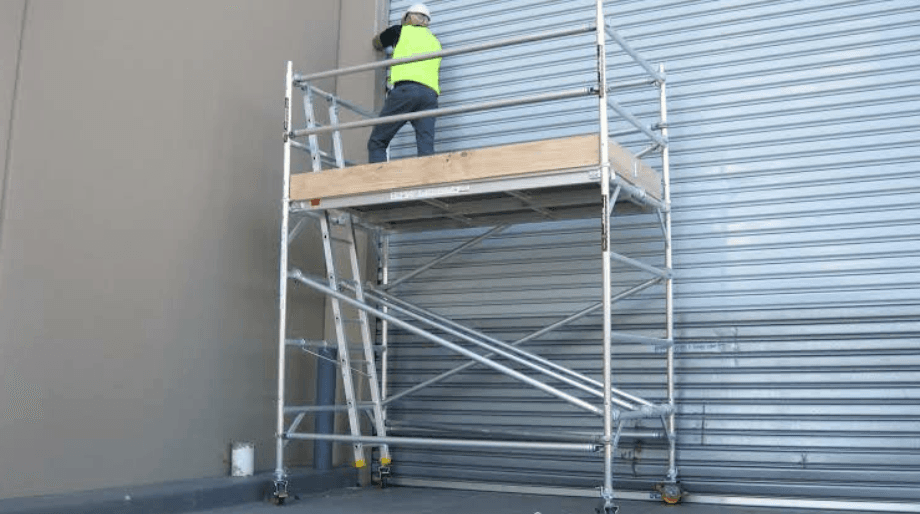

Ladders are not banned on British work sites, but the law under the Work at Height Regulations 2005 sets strict conditions on when they can be used. This article covers the rules that apply in Great Britain, where the Health and Safety Executive (HSE) is the enforcing body. Operators in Northern Ireland should check the rules that apply there, as the sources used for this article cover Great Britain only.
What the law actually says about ladders
The Work at Height Regulations 2005 do not ban ladders. The HSE states plainly that ladders are not banned , and the rules that govern them are set out in Schedule 6 of the Work at Height Regulations . The Regulations apply to all work at height where there is a risk of a fall that is liable to cause personal injury, and they make clear that ladders should be the exception rather than the default.
Under the Regulations, dutyholders must avoid work at height where possible, for example doing the work from ground level using extending equipment . Where work at height cannot be avoided, they must use work equipment or other measures to prevent falls, for example cherry pickers or scaffolding .
Ladders are a last resort and should only be used for low risk, short duration work. The Regulations provide that every employer shall ensure that a ladder is used for work at height only if a risk assessment under regulation 3 of the Management Regulations has demonstrated that the use of more suitable work equipment is not justified because of the low risk and the other conditions set out in the legislation are met. The HSE adds that ladders are a last resort and should only be used for low risk, short duration work.
Carrying out a risk assessment before you climb
The risk assessment is the step that decides whether a ladder is lawful for a particular job. Under the Regulations, every employer shall ensure that work at height is properly planned, appropriately supervised, and carried out in a manner which is so far as is reasonably practicable safe , and that planning must include the selection of equipment. The planning also has to cover planning for emergencies and rescue.
When selecting equipment, the employer must consider a number of factors. Regulation 7 requires the employer to take account of the working conditions and the risks to the safety of persons at the place where the work equipment is to be used , the distance and consequences of a potential fall , and the duration and frequency of use . The equipment itself must have dimensions that are appropriate to the nature of the work to be performed and the foreseeable loadings .
Weather matters too. The Regulations state that work at height is carried out only when the weather conditions do not jeopardise the health or safety of persons involved in the work.
The Regulations also set out who may do the work. Every employer shall ensure that no person engages in any activity, including organisation, planning and supervision, in relation to work at height or work equipment for use in such work unless he is competent to do so or, if being trained, is being supervised by a competent person.
Choosing the right ladder and using it safely
It advises that This matters for anyone hiring equipment, because a domestic ladder is not a substitute for a trade-grade one on a commercial site.
Several practical rules follow from the HSE's guidance on use. The first is positioning. The HSE advises that you should use the 1-in-4 rule to set the ladder angle, and that the ladder should extend at least 1 metre or three rungs above where you are working . You should also not work off the top three rungs .
The second rule concerns contact. HSE guidance says you should maintain three points of contact when climbing and wherever possible at the work position. On a stepladder, if two hands need to be free for a brief period of light work, the HSE advises keeping 2 feet on the same step and the body supported by the stepladder to maintain 3 points of contact.
The third rule concerns the base. Ladders should not be placed on unstable supports. HSE guidance says you should not stand ladders on movable objects, such as pallets, bricks, lift trucks, tower scaffolds, excavator buckets, vans or mobile elevating work platforms . Anyone working near electricity should also note that you should not work within 6 m horizontally of any overhead power line, unless it has been made dead or it is protected with insulation.
Ladders also need to be secured. The HSE states that ladders have to be prevented from slipping during use. For work with electricity, use a non-conductive ladder (eg fibreglass or timber) .
If you are hiring a ladder or any other access equipment, the same principles apply to the hire company's kit. For a broader look at tool and access equipment, see tool hire listings across the directory, and for local options see tool hire in London.
Inspection and checks: a practical checklist
The Regulations require inspection of work equipment. The HSE expects a user check before each use, and the pre-use check is done by the person about to use the ladder.
Use the following checklist before each climb:
- Check the feet are present, secure and not worn, since if they are missing, worn or damaged the ladder could slip.
- Look for cracked, worn, bent or loose rungs and twisted, bent or dented stiles .
- Confirm the locking mechanisms work, since a broken locking device is a common fault.
- Make sure the ladder is clean and free of oil, grease or loose material so the feet can grip.
- Check the weight rating against your own weight plus any tools or materials you carry.
- Confirm the ladder is tall enough, because using a ladder that is too short increases the risk of falling.
- Remove any ladder with a defect from service and label it so no one else uses it.
Where ladders form part of a scaffold, they are subject to separate rules. The Ladder Association guide notes that ladders that are part of a scaffold system still have to be inspected every seven days as part of the scaffold inspection requirements .
Duration, supervision and when to choose another option
The time a ladder is in use matters. HSE guidance indicates that The ladder should only be used for light, low risk work of short duration at lower levels. Before choosing a ladder, the first question should be whether the job can be done another way. Where more suitable work equipment exists, it should be used in place of a ladder.
Where a ladder is chosen, the risk assessment must record the reasons. If the task can be completed from the ground using extending equipment, that is the approach the Regulations favour.
For sites that rely on power tools alongside ladder work, the electrical supply needs its own planning. You can read about 110V and 240V site tools to understand which voltage suits a given job. Similarly, if your site also needs a power source, generator sizing for site and events explains how to match the load to the equipment. For the wider picture of hiring vehicles and trailers used with access equipment, horse trailer towing laws covers the rules that apply to towing.
Who to contact and where to start
The HSE publishes guidance on the Work at Height Regulations., and the HSE's published guidance is the authoritative reference for a site manager or hirer. The Work at Height Regulations 2005 apply in Great Britain. If you are planning ladder work for a local project, the directory can help you find suppliers in your area, including tool hire in Enfield and tool hire in Harrow.
Ladder safety comes down to a simple discipline: decide whether a ladder is the right tool, record why, check the kit before use, and keep three points of contact throughout. Anyone who hires access equipment should expect the hire company to supply equipment that meets the standards described above.
GetBrent lists local hire companies for tools, plant, vans, trailers and storage across the UK. Use the directory to compare providers and to find a supplier that can talk you through the right access equipment for your site. Costs for hire vary with duration, depot and delivery distance, so confirm the figure directly with each company before you commit.