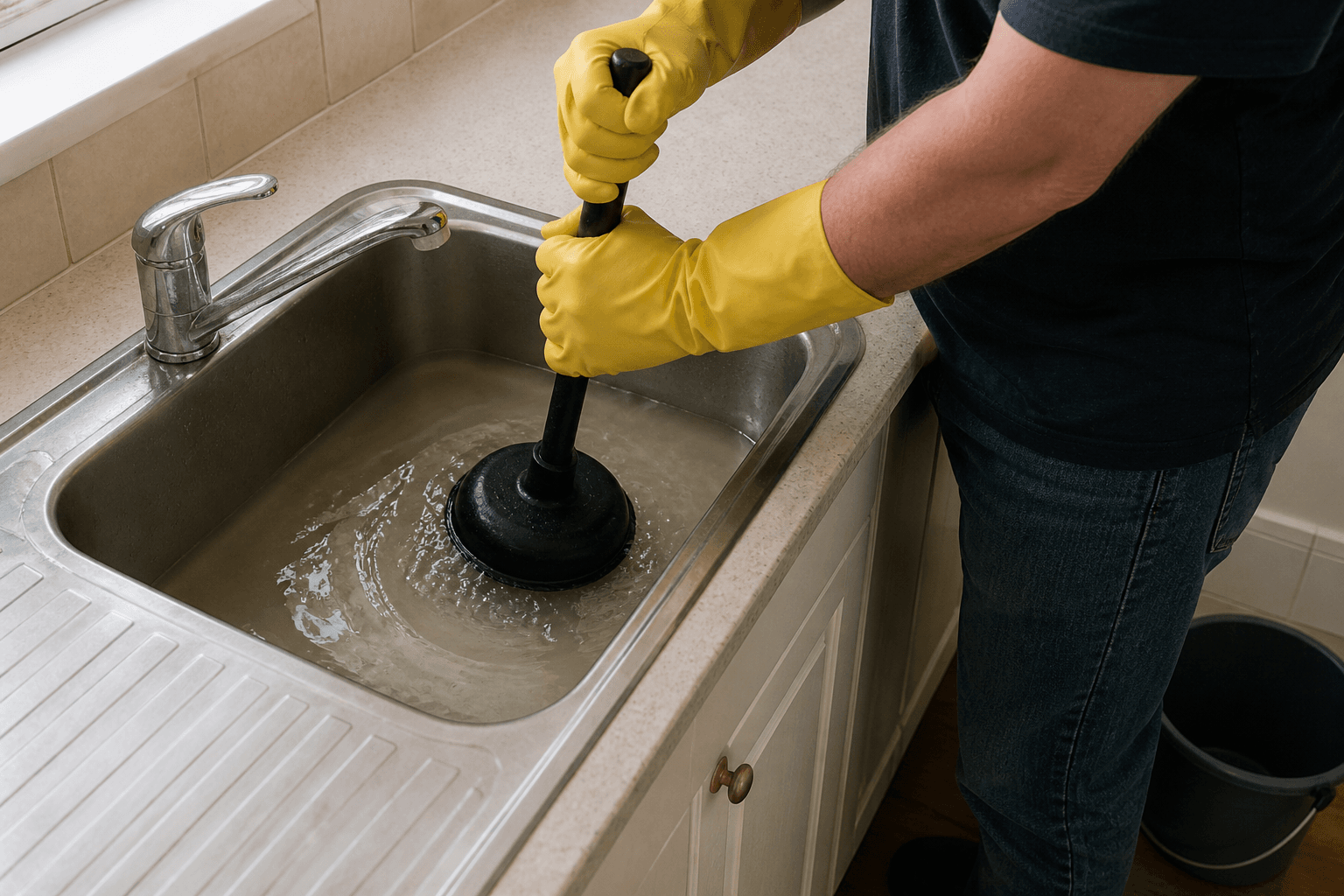
Most blocked sinks, baths and showers can be cleared without a plumber, using a plunger, a clean trap or a flexible drain snake, tried in that order. Some drains, however, belong to the water company or the local council, and some work needs a registered professional. This guide explains which jobs are safe to try at home and which are not, for households in England and Wales.
At a glance
- Start with the gentlest method: hot (not boiling on plastic) water, then a plunger, then cleaning the trap, then a drain snake.
- Never pour fats, oils or grease down any drain, and never flush wet wipes, even those labelled flushable.
- Your responsibility usually stops at your property boundary. Shared drains and public sewers normally belong to the water company.
- Do not use chemical cleaners on a blockage you plan to clear with a snake or by hand.
- Call a drainage firm or your water company if several drains back up at once, or if sewage is coming up somewhere it should not.
Safe methods, in order
Begin with the simplest approach. Remove any visible debris from the plughole, then run hot water. Pour boiling water down first only for grease blockages, and use very hot tap water rather than boiling water on plastic (PVC) pipes. One guide to clearing a sink recommends a gentle sequence: hot water, then baking soda and vinegar, then a plunger, then cleaning the U-bend, and only then a drain snake.
A plunger is the best first tool for a simple blockage. Use a flat-bottomed sink plunger for sinks and baths, and a flanged plunger for a toilet. Make sure there is enough water around the plunger head to create a seal, then pump it up and down several times. One manufacturer-style guide suggests around 10 to 15 firm pumps, and then running the tap to check the flow.
If the plunger does not work, clean the trap. Place a bucket or suitable container underneath first, because trapped water will spill when the connection is opened. Unscrew the trap, remove the debris by hand or with a brush, rinse it, and refit it. Check for drips when you run the water again.
A drain snake, also called an auger, is the next step. It reaches further into the waste pipe than a plunger can. Feed the cable in slowly, turn the handle as you push, and pull it out carefully, bringing up any material caught on it. A hand snake is best for hair and soap in sink, bath and shower waste pipes. Bail out a full basin or bath first, and never snake water that contains chemical cleaner.
Products to avoid, and why
Chemical drain cleaners are often the first thing people reach for, but they carry real risks. Avoid pouring chemical mixtures down a pipe to break up a solid blockage, and never add them to a drain you are about to clear with a snake.
Be wary of anything that might be harmful if it splashes back. Medicines, paints, spirits, weed killer, anti-freeze and brake fluid should never go down a drain at all. Baking soda and vinegar is a gentler option, but it is only worth trying as a step before the plunger, not as a substitute for clearing the blockage.
What never to pour or flush down a drain
Most blockages are caused by what goes down the pipes, so prevention matters as much as the fix. Water UK's Bin the Wipe campaign asks people to only flush the 3 Ps - pee, poo and paper - and always Bin the Wipe. Wet wipes, including those labelled flushable, do not break down in the sewer.
Fats, oils and grease are the other main cause. As fats cool, they solidify and coat the inside of pipes, catching other debris. Scrape plates into the bin before washing up, and keep a bin beside the toilet and in the bathroom for wipes, sanitary products and cotton buds. Clear the hair catcher in the bath or shower regularly.
Who is responsible for which drain
Responsibility depends on where the pipe runs and how many properties it serves, not on who noticed the problem first. Drains inside your property boundary usually remain your responsibility, while lateral drains and sewers that connect to the public sewerage system are transferred to the water and sewerage company. The table below sets out the usual split in England and Wales.
The following table shows the usual split of responsibility for each type of pipe.
| Type of drain | What it means | Usually responsible |
|---|---|---|
| Private drain | Serves only your home, inside your boundary | You, or the landlord in a rented home |
| Lateral drain | Runs from your boundary to the public sewer, outside your property | The water and sewerage company |
| Shared drain or sewer | Serves two or more properties | The water and sewerage company |
| Public sewer | The main sewer, usually under the road | The water and sewerage company |
The transfer took effect on 1 October 2011. Under the private sewers transfer, all lateral drains that connect to a public sewer became the responsibility of the sewerage undertaker. The transfer was made under the Water Industry (Schemes for Adoption of Private Sewers) Regulations 2011, and applies in England and Wales. The transfer applies in England and Wales only, so check arrangements with the relevant provider if you live in Scotland or Northern Ireland.
Be careful about digging up a lateral drain yourself. Do not commission work on a public sewer or lateral drain without checking with the water company first. If you think the blockage is theirs, contact your water company before you pay anyone to work on it.
If you rent, the landlord is usually responsible for the drains inside the property. Check your tenancy agreement and the terms set out by your landlord before you pay for any repair.
When to call a drainage firm
Some blockages are beyond a home fix. Water rising in a manhole or sewage escaping at a manhole cover should be reported to your water company, not dealt with yourself.
Check the cause before you pay. If the blockage is in a shared drain or public sewer, your water company should be the first call, and it is normally free to you. Ask any firm for a clear written quote and confirm the price directly with the company before the work starts. Costs depend on the type of blockage, the access, the equipment needed and how far the work has to go, so ask for the figure in writing.
Frequently asked questions
Can I use a drain snake on an outside drain?
A hand snake is usually too thin and short for outside drains, which are often 100 mm pipes. For outside drains and gullies, drain rods are the tool normally used instead.
Is it safe to use chemical drain cleaner?
Chemical cleaners can be harmful and should not be mixed or used alongside a snake or plunger. Try hot water, a plunger and a clean trap first.
Who pays if a shared drain is blocked?
Shared drains and public sewers are the responsibility of the water and sewerage company under the transfer, so report the blockage to them first. Your water company is best placed to confirm whether the pipe is theirs.
When a blockage will not clear, or it involves a shared drain, a lateral drain or a public sewer, get the right people involved early. GetBrent lists local plumbers, drainage firms and cleaners across England, and you can find trade services in your area to compare them. If you need a drain rod set or a drain snake for a weekend job, tool hire in London is a useful place to look. Always confirm the cost with the company before work begins.