
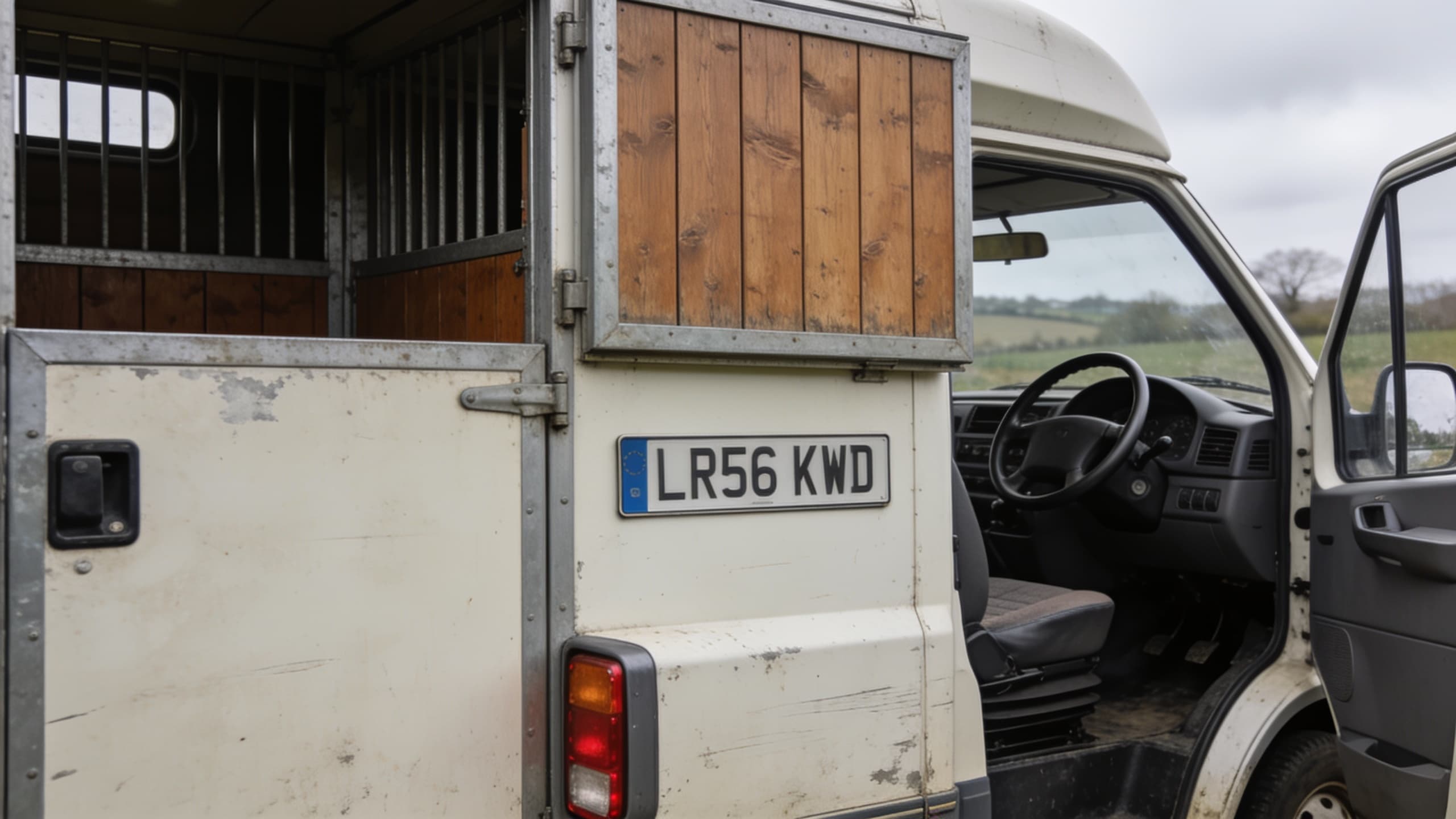
The driving licence you need to hire and drive a horsebox in the UK is determined by the vehicle's Maximum Authorised Mass (MAM) - not how much it weighs on the day you set off. Get this wrong and you risk driving without the correct entitlement, which is a serious matter under DVSA rules. Understanding the weight bands before you book a specialist vehicle hire company is therefore the single most important step.
What MAM means and why it matters
Licence requirements are based on the vehicle or trailer's Maximum Authorised Mass (MAM), not necessarily how much it weighs on the day of travel. MAM is the maximum weight a vehicle is designed to carry, including its own weight, passengers, cargo and horses. It is stated on the vehicle's plate and in its registration documents. Always ask the hire company for the MAM of the specific horsebox you intend to collect, as different lorries on the same fleet can fall into different weight bands.
Licence requirements by horsebox size
The type of horsebox you can drive depends on the driving licence you hold, the size (weight) of the horsebox, and whether you are driving privately or for commercial purposes. In the UK, horsebox licence requirements are determined by the vehicle's MAM and the driver's licence category.
Up to 3,500 kg - Category B (standard car licence)
One of the biggest advantages of a 3.5 tonne horsebox is that it can usually be driven on a standard Category B car licence. A normal car licence covers vehicles up to 3,500 kg MAM, which includes most small two-horse 3.5t horseboxes. In other words, if your horsebox has a maximum weight of 3.5 tonnes or less when loaded, you can drive it on a normal licence without extra qualifications.
3,500 kg to 7,500 kg - Category C1
A C1 licence allows you to drive vehicles between 3.5 tonnes and 7,500 kg MAM. This sits above a standard car licence but below full HGV. You need a Category C1 licence to drive a horsebox in this weight range. If the vehicle exceeds 3.5 tonnes, you need the correct licence regardless of whether you are using it privately or professionally. So even if you are transporting your own horse for leisure, competitions, or yard moves, the same rules apply.
If you passed your Category B car test before 1 January 1997, your licence normally already includes C1 entitlement up to 7.5 tonnes, so you can drive a 7.5t horsebox privately without taking another test. But always check your driving licence to confirm C1 is listed. If you passed after that date, you must take an additional test to obtain a C1 licence.
Over 7,500 kg - Category C (full HGV)
Horseboxes over 7.5 tonnes require a Category C licence, also known as an HGV licence. Obtaining a Category C licence involves a medical examination, theory tests, hazard perception tests, and practical driver training and testing. Most hire companies offering vehicles of this size will confirm the licence requirement at the point of booking.
Do you need a Driver CPC or operator's licence?
If you drive a 7.5t horsebox solely for private use - your own horses, no payment, no commercial purpose - you do not need a Driver CPC (Certificate of Professional Competence).
The position changes if any commercial activity is involved. Operators' licences are required for those who transport horses for hire and reward, or in the course of a trade or business, for vehicles over 3.5 tonnes. This covers horse transporters but also professional riders, producers, sole traders and those competing above a level deemed as amateur. Even if you do not charge directly for transporting a horse but charge for livery or training and offer transport as part of the service, that is considered commercial use. If you are uncertain whether your activity qualifies as commercial, check directly with the DVSA before hiring the vehicle.
Practical checklist before you collect a hired horsebox
- Confirm the MAM of the specific vehicle with the hire company - not just the model name.
- Check your licence counterpart on the DVLA online service to see exactly which categories are listed.
- Drivers who passed before 1 January 1997 should verify that C1 entitlement has not lapsed - some entitlements may expire at age 70 unless renewed with the DVLA.
- Confirm insurance with the hire company. Your standard car insurance does not automatically extend to a horsebox.
- Ask about the speed limiter. Many 7.5t vehicles are fitted with a speed limiter set to 56 mph, which affects motorway journey times.
- Check animal welfare requirements for the journey. Commercial animal transport over certain distances may require additional documentation; the DVSA and the relevant authorities publish current guidance.
Hiring rather than owning - what to bear in mind
Hiring a horsebox for a single event or occasional use is a practical alternative to ownership, but the legal responsibilities do not change. The hire company is responsible for ensuring the vehicle is roadworthy, correctly plated and holds a valid MOT, but the driver is fully responsible for holding the correct licence entitlement for that vehicle's MAM. Always read the hire agreement carefully, and raise any questions about the vehicle's weight category before you sign.
Firms offering horsebox hire can vary significantly by region, vehicle size and availability. Whether you need a compact two-horse box on a car licence or a larger lorry requiring C1 entitlement, using a local comparison service helps you check what is available near you. For example, you can browse specialist vehicle hire in London, specialist vehicle hire in Southampton, or specialist vehicle hire in Basildon to find and contact firms directly.
GetBrent lists horsebox hire companies and specialist vehicle hire firms across the UK, so you can compare local operators and get in touch with them directly. Search your area on GetBrent to find the right vehicle and the right firm for your next journey.